Radiator Cold at the Top or Bottom? How to Bleed and Balance UK Radiators in 15 Minutes
 By Harry Bennett
•
•
15 min read
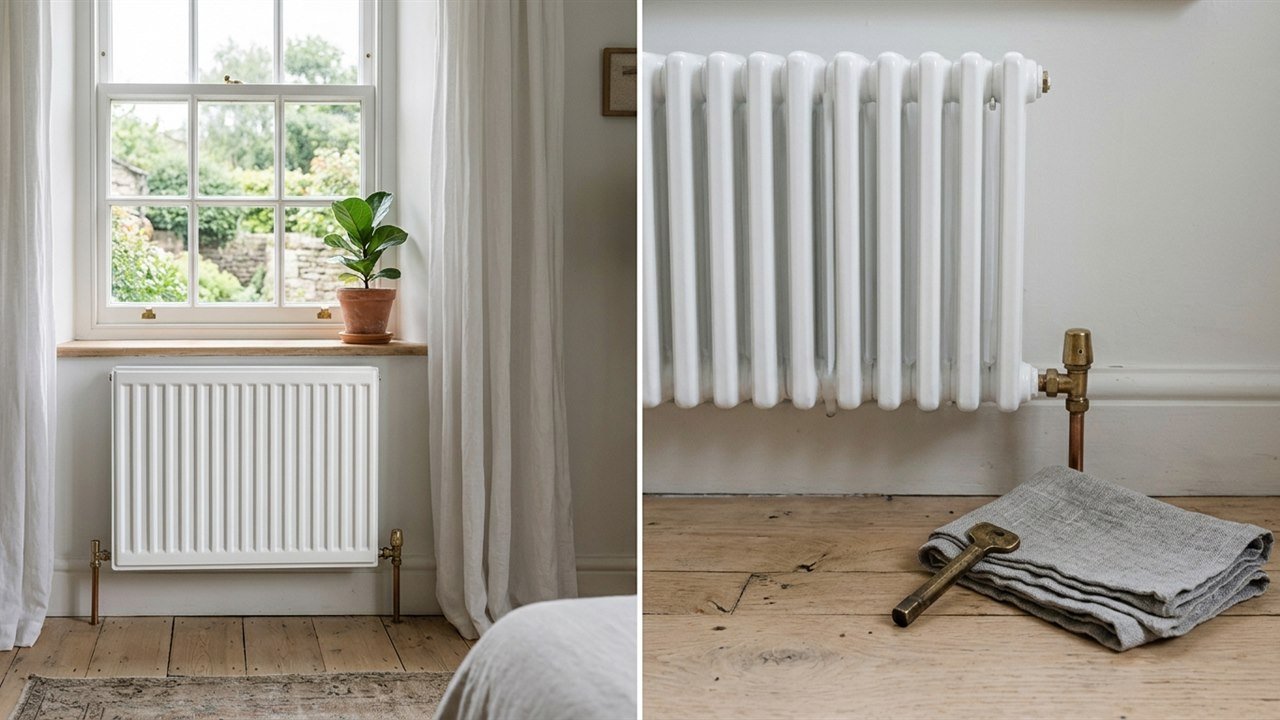
If your radiator is cold at the top and hot at the bottom, trapped air is stopping hot water from filling the panel — a five-minute fix with a £2 brass bleed key. If it is cold at the bottom and hot at the top, bleeding will not solve it: thick black iron-oxide sludge has settled at the base of the radiator, blocking circulation.
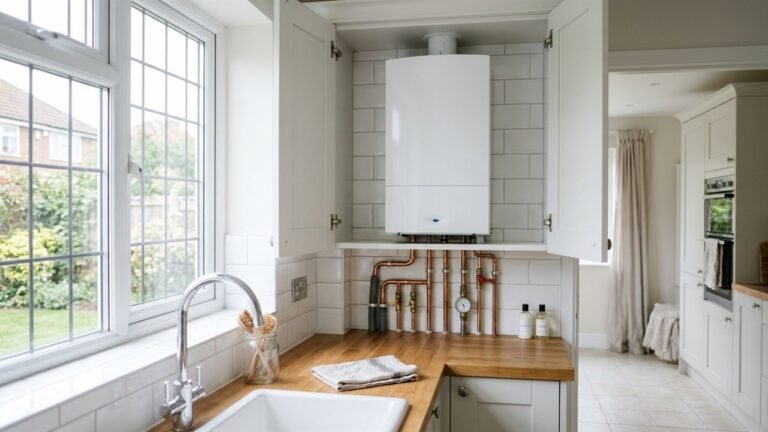
Running a central heating system with airlocked or poorly balanced radiators forces your boiler to burn extra gas for longer just to satisfy the hallway thermostat, while leaving upstairs bedrooms or the back kitchen chilly. Here is how to diagnose exactly what is wrong with each radiator in your home, bleed the system cleanly without flooding your carpet or locking out your combi boiler, and balance the lockshield valves so every room heats up evenly.
Quick Answer & Key Takeaways
- Cold at the top: Trapped air or hydrogen gas. Bleed the radiator with the heating switched off, starting downstairs and finishing upstairs.
- Cold at the bottom: Magnetite sludge build-up. Needs a chemical cleaner (such as Sentinel X400 or Fernox F3), manual flush, or professional powerflush plus fresh corrosion inhibitor.
- Always check boiler pressure afterwards: Bleeding releases pressure from sealed combi and system boilers. Top up via the filling loop until the cold gauge reads 1.2 to 1.5 bar.
- One radiator completely cold: Check for a stuck pin underneath the thermostatic radiator valve (TRV) head before calling a plumber.
- Downstairs scorching, upstairs lukewarm: Your system needs balancing via the lockshield valves — a 15-minute job that costs nothing and boosts condensing boiler efficiency.
Quick Diagnosis: What Your Cold Radiator Is Telling You
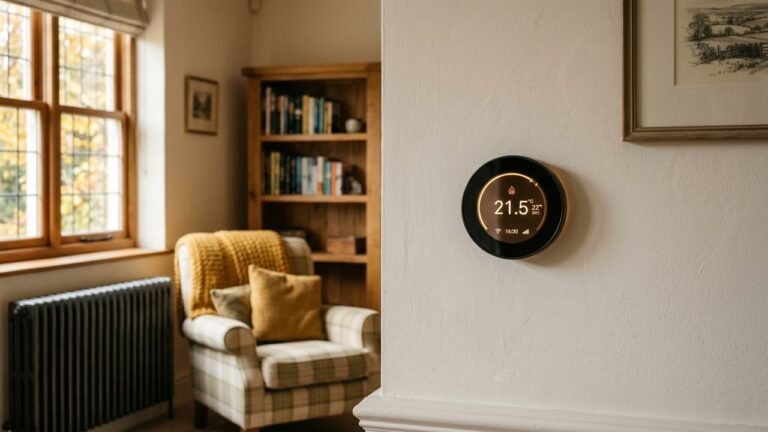
Before grabbing a radiator key, turn your heating on for 15 minutes and carefully run the back of your hand across the top, middle, and bottom of every radiator in the house. Different cold patterns point to completely different causes — and save you wasting an afternoon bleeding radiators that actually have a jammed valve or sludge blockage.
| Radiator Symptom | Most Likely UK Cause | Fix Method | Typical UK Cost |
|---|---|---|---|
| Cold at the top, hot at the bottom | Trapped air or corrosion gas | Bleed radiator + top up boiler pressure | £0 – £3 (bleed key) |
| Cold at the bottom, hot at the top | Black magnetite sludge settled in base | Chemical flush, radiator flush-out, or powerflush | £20 DIY cleaner / £380 – £750 powerflush |
| Completely cold (pipes cold too) | Stuck TRV pin or closed lockshield valve | Free the TRV pin gently / open lockshield | £0 DIY / £90 – £150 plumber |
| Warm near boiler, cold furthest away | Unbalanced central heating system | Balance lockshield valves across all radiators | £0 DIY / £100 – £180 engineer |
| Gurgling, kettle-like or banging noises | Airlock, low system pressure, or pump issue | Bleed all radiators, re-pressurise, check pump | £0 DIY / £90 – £220 engineer |
| Needs bleeding every 2 to 4 weeks | Active internal corrosion (hydrogen gas) or micro-leak | Add corrosion inhibitor; check for hidden leaks | £15 – £25 inhibitor / £120+ leak check |
What You Need Before You Bleed Your Radiators
You do not need a specialist plumbing toolkit — everything costs under £5 at Screwfix, Toolstation, B&Q, or a local high-street ironmonger:
- A radiator bleed key: Standard brass square keys cost £1.50 to £3 and fit 95% of UK radiators. Many newer steel panel radiators also have a slot for a flathead screwdriver.
- An old dark-coloured towel or rag: Central heating water often contains black iron oxide that permanently stains pale carpets, oak floorboards, and painted skirting boards.
- A shallow bowl, jug, or old mug: To catch the first splash of water from the tiny bleed pinhole.
- An adjustable spanner or pliers (for balancing only): Needed if you plan to adjust the lockshield valves afterwards.
Step-by-Step: How to Bleed UK Radiators Safely in 10 Minutes
One of the biggest mistakes homeowners make is bleeding radiators while the central heating pump is still running. Not only can piping-hot water spray out and scald your fingers, but on older open-vented systems (with a small feed-and-expansion tank in the loft), a running pump can actually suck more air into the circuit through the open bleed valve. Follow this exact order instead:
- Switch the central heating OFF and wait 15 minutes: Once you have felt which radiators have cold tops, turn the heating off at the programmer or thermostat. Waiting 15 minutes lets the circulation pump stop and allows scalding water to cool to a safe handling temperature while air rises cleanly to the top of each panel.
- Start downstairs, furthest from the boiler, and work up: Begin on the ground floor with the radiator furthest away from the boiler, then move towards the boiler. Finish upstairs — especially tall heated bathroom towel rails, which act like chimneys for trapped air.
- Protect the floor and wall: Lay an old towel directly beneath the bleed valve end (the tiny square peg set inside a round nut at the top left or top right corner of the radiator) and hold your rag and mug directly underneath the small outlet pinhole.
- Turn the bleed key anti-clockwise by a quarter to half a turn ONLY: Never unscrew the bleed screw all the way out, or hot pressurised water will gush across the room and you will struggle to screw it back in. A gentle quarter-turn is plenty.
- Listen for the hiss and wait for a steady trickle: Trapped air escapes with a clear hissing sound. Keep holding the mug in place as the hiss splutters and turns into a smooth, steady stream of water with no bubbles.
- Close the valve clockwise firmly (do not over-tighten): As soon as solid water appears, turn the key clockwise until snug. Brass bleed valves are soft metal — cranking them aggressively can round off the square spindle or strip the thread.
- Check and top up your combi boiler pressure: Walk straight to your boiler and inspect the pressure gauge (either a circular dial or digital readout). Every time you release air and water from a sealed system, pressure drops. If the needle has fallen below 1.0 bar (when cold), open the two little black or blue levers on the silver braided filling loop underneath the boiler until the gauge climbs gently to 1.2–1.5 bar, then close both valves securely.
- Fire the heating back up and re-check: Run the heating for 20 minutes. Every bled radiator should now feel evenly warm right to its top corners, and your boiler gauge should sit comfortably around 1.8 to 2.2 bar while hot.
Combi vs System vs Regular Boilers: How to Re-Pressurise After Bleeding
One of the most common panics after bleeding UK radiators happens when a homeowner walks into the kitchen to check the boiler pressure gauge — and either sees the needle sitting in the red zone, or cannot find a pressure gauge at all. Exactly what you do after bleeding depends entirely on which of Britain’s four heating setups your property uses.
| UK Heating System | Pressure Gauge? | Target Cold Pressure | How It Refills After Bleeding | Key Watch-Out |
|---|---|---|---|---|
| Sealed Combi Boiler | Yes (front dial or LCD) | 1.0 – 1.5 bar | External silver braided filling loop (or internal Worcester/Vaillant key) | Close both loop valves firmly; never exceed 1.5 bar cold |
| Sealed System Boiler | Yes (boiler or airing cupboard) | 1.0 – 1.5 bar | External filling loop near boiler or hot water cylinder | Check the red expansion vessel area if pressure climbs fast when hot |
| Regular / Open-Vented Boiler | No | Gravity-fed (auto) | Small Feed & Expansion (F&E) tank in the loft refills automatically | If upstairs radiators stop refilling, the loft ballcock may be stuck |
| London Communal / HIU Flat | On Heat Interface Unit (HIU) | 1.2 – 1.5 bar (if closed flat loop) | Check lease/building manual — some communal loops are landlord-only | Never drain or interfere with shared building risers |
If you own a regular heat-only boiler with two cold-water tanks in the loft (a big domestic cold tank and a smaller central-heating Feed & Expansion tank), stop hunting for a filling loop — you do not have one. Gravity automatically pushes fresh water down from the small loft tank to replace every pocket of air you bleed out. However, if you open an upstairs bleed valve and hear nothing at all (no hiss and no water), the float valve (ballcock) in your loft header tank may have seized shut or the cold feed pipe may be choked with sludge, which needs a plumber to clear safely.
Troubleshooting: Stuck Bleed Valves, Microbore Pipes & Over-Filled Boilers
Real British heating systems — especially 30-year-old radiators coated in six layers of white gloss paint — rarely behave as cleanly as brand-new showroom panels. Here is how to handle the three trickiest DIY hiccups safely:
- Painted-over or rounded bleed valve: If thick gloss paint has sealed the square peg, gently score around the edge with a Stanley knife before fitting the brass key so it seats all the way down. If the tiny square peg has already been chewed round by previous attempts, stop immediately — do not force it with mole grips unless you know how to isolate both radiator valves and drain the panel, because snapping the brass plug releases pressurised water. A heating engineer can replace the entire ½-inch brass vent bung in ten minutes.
- 8mm or 10mm microbore pipework (common in 1970s–1990s UK estates): Many modern-era British houses and flats use skinny 8mm or 10mm copper pipes instead of standard 15mm copper. Microbore pipes clog far faster with magnetite sludge than wider pipes, causing individual downstairs radiators to go stone cold even when completely free of air. Regular dosing with corrosion inhibitor (every 5 years) and a magnetic filter are essential on microbore systems — and avoid aggressive high-velocity powerflushing without an engineer assessing the manifold first.
- Accidentally over-pressurised the boiler above 2.0 bar: If you left the filling loop open a few seconds too long and the cold gauge shot up to 2.5 bar, close both filling-loop valves immediately. To drop the pressure safely back down to 1.3 bar, place a jug under your nearest downstairs radiator bleed valve and slowly bleed out roughly half a mug to a full mug of water while checking the gauge. Leaving a boiler over-pressurised forces hot water out through the safety Pressure Relief Valve (PRV) pipe outside, which can leave the PRV dripping permanently.
Radiator Still Completely Cold? Check for a Stuck TRV Pin
If an individual radiator stays stone cold from top to bottom after bleeding — and turning its numbered thermostatic radiator valve (TRV) up to 5 makes zero difference — the little metal pin inside the valve body has probably seized shut over the summer. This happens constantly in UK homes when TRVs are turned down to 0 or * from April to October.
Fixing a stuck TRV pin takes two minutes without draining a drop of water:
- Twist the TRV dial to its highest number (5) to release tension, then unscrew the silver knurled metal ring at the base of the plastic head anti-clockwise (hand-tight or a gentle nudge with grips).
- Lift the plastic TRV head straight off to expose a thin brass or stainless-steel pin sticking up out of the valve body.
- Press down firmly on the pin with the flat side of a spanner or the handle of a screwdriver. A healthy pin springs back up by 3mm to 5mm smoothly. If it is jammed down, tap the side of the brass valve body gently a few times and press the pin repeatedly until it pops free. Never yank the pin upwards with pliers — pulling it right out of the gland seal will cause a pressurised fountain of radiator water.
- Screw the plastic TRV head back on. Within five minutes, the radiator inlet pipe should surge hot.
How to Balance Your Radiators (When Some Rooms Hog All the Heat)
Water is lazy: it always takes the path of least resistance. In a two-storey Victorian terrace or semi-detached house, hot water pumped out of a kitchen combi boiler naturally rushes through the downstairs kitchen and hallway radiators and straight back to the boiler, starving the upstairs back bedroom or loft conversion of flow. That is why your downstairs radiators can feel blazing hot while the bedroom radiator stays barely lukewarm even after bleeding.
Balancing restricts the flow slightly through the radiators nearest the boiler so hot water is forced evenly around the entire circuit. It also lowers your boiler’s return water temperature, which works hand-in-hand with setting your combi boiler flow temperature to 60°C to keep your heating in peak condensing mode.
- Locate the lockshield valve on every radiator: Every UK radiator has two valves at the bottom. One is the numbered TRV (or wheelhead) that you adjust day to day; the other has a plain white or chrome plastic cap with no numbers. Pull that plastic cap straight off (some have a tiny screw on top) to reveal a flat-sided brass spindle — that is the lockshield valve.
- Open everything fully and switch heating on from cold: Turn every TRV to maximum (5) and turn every lockshield spindle anti-clockwise until fully open. Turn the heating on from cold and walk round the house to note the exact order in which each radiator gets hot (number them 1st, 2nd, 3rd, etc.).
- Throttle back the fastest radiators first: Turn the heating off to cool, or work carefully while running. Go to the radiator that heated up first (usually closest to the boiler). Close its lockshield clockwise completely, then open it anti-clockwise by just one-quarter to half a turn.
- Gradually open more as you move further from the boiler: Give mid-circuit radiators roughly half to one full turn open, and leave the very last, slowest radiator (often the upstairs back bedroom) opened by 1.5 to 2 full turns or fully open.
- Check pipe temperatures across each radiator: After 20 minutes of heating, feel both copper pipes entering the bottom of each radiator (or use an inexpensive £12 infrared thermometer or clip-on pipe thermometer). Ideally, the flow pipe entering the radiator should feel noticeably hotter than the return pipe leaving it — roughly a 12°C to 15°C drop across each panel. If the return pipe is nearly as scorching hot as the flow pipe, close that radiator’s lockshield another eighth of a turn.
- Pop the plastic caps back on: Once every radiator warms up within a few minutes of the others, replace the lockshield caps and dial your TRVs back to your preferred room temperatures.
What If Your Radiator Is Cold at the Bottom? (Fixing Sludge)
Cold bottom patches mean heavy black magnetite sludge — tiny rust particles created as water and dissolved oxygen react with the steel inside your radiators — has settled like silt at the bottom of the panel. Bleeding lets gas out of the top; it cannot lift thick sludge off the bottom.
Your options depend on how severe the blockage is:
- Single sludged radiator (confident DIYer): In spring or summer, isolate both valves (count the exact turns on the lockshield so you can restore the balance), drain the radiator into a shallow tray, lift it off its wall brackets, carry it into the garden, and flush a garden hose through both ends until the water runs clear. Refit, refill, and dose the system with fresh inhibitor.
- Mild system-wide sludge: Add a bottle of chemical sludge remover such as Sentinel X400 or Fernox F3 (£18 to £25) via a towel-rail bleed port or magnetic filter, run the heating normally for two to four weeks so it suspends the debris, then drain, flush thoroughly, and add Sentinel X100 or Fernox F1 corrosion inhibitor.
- Severe multi-radiator blockage or noisy boiler: Book a heating engineer for a MagnaCleanse flush (£250 to £400) or full powerflush (£450 to £750 in London and the South East) and ask them to fit an inline magnetic sludge filter (such as an Adey MagnaClean Pro2 or Fernox TF1, typically £150–£240 fitted) on the return pipe beneath the boiler so magnetite is trapped before it can ruin the boiler’s plate heat exchanger or pump.
Adding radiator checks to your autumn routine makes a huge difference alongside our UK winter home maintenance checklist, and helps make sure your timed heating schedule delivers fast, even warmth — see our data on whether it is cheaper to leave heating on low all day in the UK.
UK Safety, Tenancy & When to Call a Heating Engineer
Scalding and corrosion gas warning: Always switch the heating off and let radiators cool before bleeding. If a radiator needs bleeding every few weeks and smells slightly metallic, the gas inside is often hydrogen generated by internal corrosion — never bleed a radiator near an open flame, lit candle, or cigarette, and arrange to have corrosion inhibitor topped up.
UK tenants and landlords: Under Section 11 of the Landlord and Tenant Act 1985, UK landlords are legally responsible for keeping space-heating installations in proper working order. Gently bleeding a modern radiator is generally considered minor routine upkeep, but if a bleed valve looks heavily rusted, rounded off, or painted shut — or if radiators are sludged, leaking, or the boiler loses pressure repeatedly — do not force the valve. Report it in writing to your landlord or letting agent immediately so a qualified heating engineer handles it. For full clarity on grey areas, read our guide to landlord vs tenant repairs in the UK.
Frequently Asked Questions
Should the heating be on or off when bleeding UK radiators?
Switch the heating off and wait 10 to 15 minutes before bleeding. Turn it on first only to find which radiators have cold spots at the top. Bleeding while off prevents scalding sprays and stops the circulation pump from pulling fresh air back into open-vented pipework.
What happens if I forget to top up my combi boiler pressure after bleeding?
If bleeding drops your sealed system pressure below around 0.5 to 0.8 bar, most modern UK combi boilers (Worcester Bosch, Vaillant, Ideal, Baxi) will display a low-pressure fault code (such as F1, F22, or EA) and lock out for safety until you re-pressurise the system to 1.2–1.5 bar via the filling loop.
Why did dirty black water come out when I bled my radiator?
Dark brown or black radiator water indicates magnetite (iron oxide) rust floating in the system, usually because chemical corrosion inhibitor has weakened over the years or was never added after a repair. Clear or slightly straw-coloured water is healthy; thick inky water means your system is overdue a flush and fresh bottle of inhibitor.
How often should you bleed radiators in the UK?
A healthy, properly inhibited UK central heating system usually only needs bleeding once a year — ideally in late September or October before the main heating season starts. If you have to bleed the same radiator every month, you either have active internal corrosion generating hydrogen gas or a tiny hidden leak drawing air in.
Do I need to re-bleed radiators after balancing them?
Not usually, because balancing only adjusts the internal flow restriction of the lockshield valves without opening the system to air. Always bleed all radiators first, check boiler pressure, and then balance the lockshields so trapped air pockets do not throw off your pipe temperature checks.
What if I cannot find the bleed valve on a modern flat-panel or designer radiator?
On sleek modern flat-panel and vertical column radiators, manufacturers hide the bleed vent so it does not spoil the front finish. Run your fingers carefully along the back top-left and top-right corners behind the panel — you will feel a small recessed white or chrome square plug. On tall chrome bathroom towel rails, the bleed screw sits flush on top of one of the vertical upright tubes.
How much gas can bleeding and balancing radiators actually save in the UK?
When air pockets and poor balancing cut effective radiator heat output by 15% to 25%, your boiler stays running far longer to satisfy the room thermostat and returns overly hot water that prevents condensing. Restoring full panel area and a healthy 12°C–15°C temperature drop across radiators typically trims 5% to 8% off winter space-heating gas use — around £40 to £75 a year in an average three-bedroom house at 6.2p/kWh — for the £2 price of a brass key.
About Harry Bennett
Harry is the editorial lead at London Homecare, researching practical home maintenance, damp prevention, laundry care, and energy-saving solutions tailored to UK flats, terraced houses, and British weather conditions.