The 60°C Combi Boiler Trick: How Lowering Flow Temperature Cuts UK Gas Bills
 By Harry Bennett
•
•
15 min read
Most UK combi boilers leave the factory set to a central heating flow temperature of 75°C to 80°C — a setting so hot that it stops a modern condensing boiler from actually condensing. Turning that single dial or digital setting down to 60°C takes less than two minutes, costs nothing, and trims roughly 6% to 12% off a typical British household’s gas bill without making your living room any colder.
If your radiators currently feel blisteringly hot to the touch and your smart meter climbs sharply every time the heating clicks on, your boiler is almost certainly throwing latent heat straight out of the flue into the street. Here is exactly how the 60°C combi boiler flow temperature trick works, how to adjust it on the main UK boiler brands, and the one critical safety rule if you have a hot water cylinder instead of a combi.
Quick Answer & Key Takeaways
- The target setting: Lower your combi boiler’s central heating flow temperature (the radiator icon) to 60°C. In a well-insulated flat or new-build, 55°C often works even better.
- Why it saves gas: Modern UK condensing boilers only hit their advertised 90%+ efficiency when water returning from the radiators is below 55°C. At an 80°C flow temperature, return water comes back too hot to trigger condensing.
- Typical UK saving: Between £65 and £120 per year on a medium-to-high gas tariff (benchmarked at 6.2p/kWh), based on Nesta and Heating Hub field trials.
- Do not touch if you have a hot water tank: If you have a system or regular boiler with a separate hot water cylinder, keep the boiler flow temperature at 65°C or above (unless your boiler has independent hot water and heating flow controls) to avoid Legionella risk.
- Room warmth stays the same: Your wall thermostat still controls how warm the house gets; rooms simply take 10 to 15 minutes longer to reach target temperature on freezing mornings.
What Is Boiler Flow Temperature (And How Is It Different from Your Room Thermostat)?
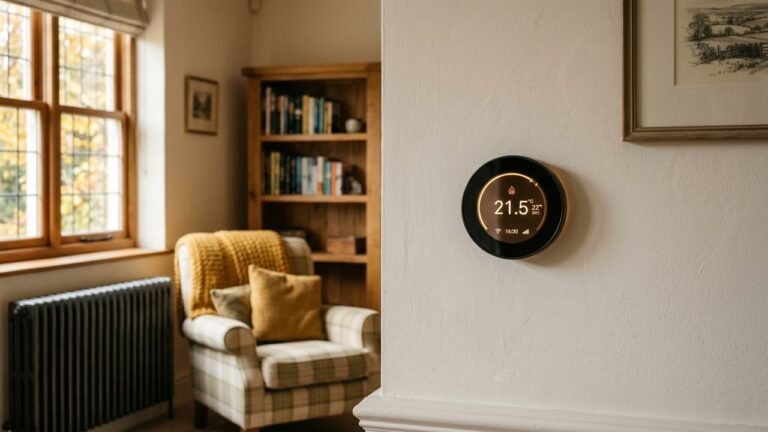
Many UK homeowners confuse three separate temperature controls, which is why so many boilers sit untouched at factory settings for a decade. Knowing which control does what prevents you from accidentally giving yourself a lukewarm shower or a chilly front room.
- Room thermostat (wall or wireless): Measures the air temperature inside your home (typically set between 18°C and 21°C). It tells the boiler when to turn on and off.
- Central heating flow temperature (radiator symbol on the boiler): Controls how hot the water is when it leaves the boiler to travel around your radiators. This is the setting we are lowering to 60°C.
- Domestic hot water temperature (tap symbol on a combi boiler): Controls how hot the water gets at your kitchen sink, basin, and shower. On a combi boiler, this is completely separate from the heating circuit and can sit comfortably at 48°C to 55°C.
Changing the central heating flow temperature does not lower your room thermostat. If your hallway thermostat is set to 19.5°C, your home will still warm up to 19.5°C — your boiler will just burn gas far more efficiently while getting there.
The Physics Behind the 60°C Trick: Why Condensing Boilers Waste Gas at 75°C
Since April 2005, UK Building Regulations have required almost every replacement gas boiler installed in England, Wales, Scotland, and Northern Ireland to be a high-efficiency condensing model. If your boiler was fitted in the last twenty years — and has a white plastic condensate pipe running to an outside drain or under your kitchen sink — it is a condensing boiler.
When natural gas burns inside the heat exchanger, it produces hot flue gases rich in water vapour. A non-condensing boiler from the 1990s vented all of that steam straight outside through the flue, wasting roughly 15% to 20% of the energy you paid for. A condensing boiler passes those exhaust gases over a secondary heat exchanger so the water vapour cools down, turns back into liquid water (condensate), and releases its hidden latent heat into your central heating system.
Here is the catch that installers rarely explain at handover: flue gases only condense when the water returning from your radiators is cooler than 54°C to 55°C (the dew point of natural gas combustion products).
In a typical UK central heating system, water loses roughly 15°C to 20°C as it travels around the radiators and returns to the boiler. Follow the maths:
- Flow set to 80°C: Water returns to the boiler at roughly 60°C to 65°C. That is well above the 55°C dew point. The boiler cannot condense at all and drops to around 82%–84% efficiency.
- Flow set to 70°C: Water returns at roughly 52°C to 55°C. The boiler sits right on the borderline, condensing weakly at best.
- Flow set to 60°C: Water returns at roughly 40°C to 45°C. The flue gases condense heavily inside the heat exchanger, pushing real-world efficiency up to 90%–93%.
- Flow set to 55°C: Water returns at roughly 38°C to 42°C, unlocking near-peak condensing efficiency of 93%–95% on milder autumn and spring days.
You can often spot this outside your house: lowering the flow temperature reduces wasted exhaust heat escaping through the flue and increases steady condensation dripping down the white condensate drain pipe.
How Much Can Lowering Flow Temperature Save on UK Gas Bills?
The exact saving depends on what your boiler is currently set to, how leaky your property is, and how much gas you burn over the winter heating season. UK innovation charity Nesta’s Money Saving Boiler Challenge found that households turning down an overly high combi flow temperature cut space-heating gas use by an average of 9% (typically ranging from 6% to 12% depending on starting temperature).
The table below models an average UK three-bedroom semi-detached house or Victorian terrace using 12,000 kWh of space-heating gas per year at a baseline 80°C flow temperature, benchmarked at a representative Ofgem-level gas unit rate of 6.2p per kWh (excluding the fixed daily standing charge, which does not change with usage).
| Boiler Flow Temp | Est. Return Temp | Condensing Mode | Typical Real Efficiency | Est. Annual Heating Gas (kWh) | Est. Annual Cost (at 6.2p/kWh) | Yearly Saving vs 80°C |
|---|---|---|---|---|---|---|
| 80°C (old default) | 62°C – 65°C | No (non-condensing) | ~82% | 12,000 kWh | £744 | Baseline (£0) |
| 75°C (common factory) | 58°C – 60°C | No | ~84% | 11,715 kWh | £726 | £18 |
| 70°C | 53°C – 55°C | Borderline | ~86% | 11,440 kWh | £709 | £35 |
| 60°C (recommended) | 42°C – 45°C | Yes (active) | ~91% | 10,810 kWh | £670 | £74 |
| 55°C (well-insulated) | 38°C – 40°C | Yes (peak) | ~94% | 10,470 kWh | £649 | £95 |
In larger or draughtier four-bedroom detached homes or uninsulated solid-wall London terraces burning 16,000 to 18,000 kWh of gas a year, the same drop from 80°C to 60°C can save £100 to £125 a year. Even better, lowering flow temperature reduces thermal stress on the boiler’s main heat exchanger and stops short-cycling — the wasteful habit of boilers firing up at full blast for three minutes, overshooting, shutting down, and repeating all evening.
Step-by-Step: How to Lower Your Combi Boiler Flow Temperature to 60°C
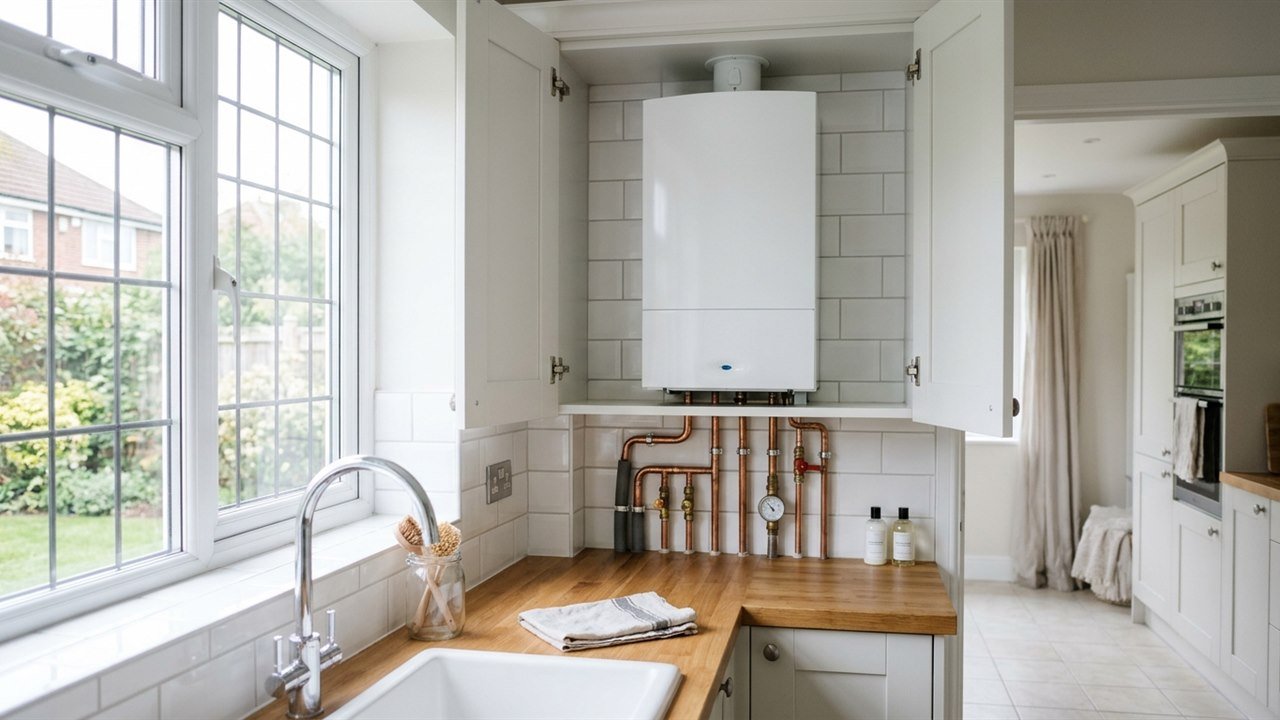
Before touching the boiler controls, confirm that you definitely have a combi boiler. A combi has no hot water cylinder in an airing cupboard and no cold-water storage tanks in the loft — just the wall-mounted boiler itself, usually in the kitchen, utility room, or hallway cupboard, with two separate temperature icons on the front panel (a radiator and a tap).
- Take a quick phone photo of your current settings: Snap a picture of the front display or dial positions first so you always know where everything started.
- Locate the central heating control: Look for the radiator icon. Ignore the tap icon (hot water) and ignore any pressure gauge dial (which should sit between 1.0 and 1.5 bar when cold).
- Adjust digital displays to 60°C: On boilers with a digital screen, press the radiator button (or press + / – beneath the radiator symbol) until the display reads 60°C, then wait five seconds or press OK to save.
- Adjust analogue dials accurately: Many older UK combis use a numbered dial (1 to 6, or “min” to “max” with an “e” for Eco). If there are no degree markings, turn the dial to roughly the 12 o’clock to 1 o’clock position — usually between 3 and 4 on a 1–6 scale, or just below the “e” mark on Worcester Bosch Greenstar models. Check the exact table for your brand below.
- Leave the tap temperature alone (or set to 50°C–55°C): Your shower and kitchen sink water does not need to be scalding at 65°C, because you only end up mixing in cold water anyway. Setting a combi’s tap temperature to 50°C–52°C is comfortable and cuts limescale build-up inside the plate heat exchanger in hard-water areas like London and the South East.
- Test over 48 hours of normal winter weather: Give the house two evenings to settle. If every room reaches your thermostat target comfortably, leave it at 60°C — or try nudging down to 55°C in mild weather.
Combi vs System vs Regular Boilers: Which UK Boilers Can Safely Drop to 60°C?
Before you adjust a single dial, you need to be certain which type of heating system is installed in your home. Roughly two-thirds of UK properties now run on a combi boiler, but millions of three- and four-bedroom family houses, older maisonettes, and Victorian semis still use a system boiler (sealed heating plus a hot water cylinder in an airing cupboard) or a regular heat-only boiler (a hot water cylinder plus two cold-water feed tanks in the loft).
On a combi boiler, domestic hot water is heated instantaneously from the cold mains through a separate plate heat exchanger, so no warm water sits stagnant in a storage tank. That is why you can safely drop the central heating flow temperature to 60°C or 55°C. On system and regular boilers with a single flow-temperature dial feeding both the radiators and the copper heating coil inside the hot water cylinder, dropping flow below 65°C risks leaving stored tank water lukewarm — below the 60°C safety threshold required to eliminate Legionella bacteria.
| UK Heating System Type | How to Spot It | Safe Radiator Flow Temp | Hot Water / Legionella Rule | DIY Safe? |
|---|---|---|---|---|
| Combi boiler (2005+ condensing) | Two temp icons (radiator + tap); no hot water cylinder or loft tank | 55°C – 60°C | Tap icon 48°C–55°C (no stored tank risk) | Yes — user dial |
| System boiler (single-circuit dial) | One heating dial + separate pressurised cylinder in cupboard | 65°C – 68°C | Cylinder stat must stay at 60°C+ | Only down to 65°C |
| System boiler (PDHW / dual-flow) | Separate boiler settings or OpenTherm priority hot water | 55°C – 60°C (heating only) | Boiler boosts to 70°C+ automatically for tank | Yes (via control menu) |
| Regular / Heat-only boiler | Boiler + airing-cupboard cylinder + cold-water loft tanks | 65°C – 68°C | Cylinder stat must stay at 60°C+ | Only down to 65°C |
| Pre-2005 non-condensing boiler | No white plastic condensate pipe; standing pilot or cast-iron exchanger | Keep at 65°C – 75°C | No condensing gain; too low risks flue rot | Leave at 65°C+ |
If you have a system boiler with a hot water cylinder and want the full condensing savings on your radiators without risking cylinder hygiene, ask your Gas Safe engineer at your next annual service whether your boiler supports Priority Domestic Hot Water (PDHW) or manufacturer weather compensation. These controls allow the boiler to run your radiators gently at 50°C–58°C all evening, then automatically ramp up to 72°C solely during the 30-minute hot-water cylinder reheat window.
Exact Settings for Popular UK Combi Boiler Brands
Because British kitchens are packed with a handful of major boiler ranges, here is where the 60°C mark sits on the most common models:
- Worcester Bosch Greenstar i / Si / CDi (analogue dial): Turn the radiator dial to roughly number 3 to 3.5 (just below the “e” Eco mark, which typically represents ~65°C on older Greenstar models). On the newer Greenstar 4000 and 8000 digital screens, press the radiator button and set directly to 60°C.
- Vaillant ecoTEC plus & ecoTEC pro: Press the + or – button under the radiator symbol (or rotate the upper-left dial on older dials) until the LCD flashes 60°C. On newer touch-panel models, tap the radiator icon, adjust to 60°C, and tap the tick to confirm.
- Ideal Logic+ / Logic Max / Vogue: Turn the right-hand dial (marked with a radiator symbol) to the 12 o’clock position or just left of the green “e” zone; digital Vogue and Logic Max models show the exact temperature on screen as you turn.
- Baxi 600 / 800 / EcoBlue / Duo-tec: Rotate the radiator dial (usually left-hand side on Duo-tec, or digital buttons on 600/800) until the screen reads 60°C.
- Viessmann Vitodens 050-W / 100-W: Tap the radiator symbol on the touch panel and use the up/down arrows to set 60°C, then tap OK.
UK Safety Warning: Hot Water Cylinders, Legionella & Gas Safe Rules
Do not lower the boiler flow temperature to 60°C if you have a conventional (regular) or system boiler with a hot water storage cylinder — unless your boiler has genuinely separate flow temperature controls for heating and hot water (such as an OpenTherm or manufacturer-specific weather-compensation setup with cylinder priority).
Stored hot water in a UK cylinder must be heated to at least 60°C to kill Legionella pneumophila bacteria, which thrives between 20°C and 45°C. Because the heating coil inside a cylinder needs water hotter than the tank itself to transfer heat efficiently, a single-circuit system boiler usually needs a flow temperature of 65°C to 68°C to bring stored cylinder water safely above 60°C.
Tenant and Gas Safe note: Adjusting the external user-facing temperature dial or digital display on a combi boiler is completely safe and does not void a warranty or breach a UK tenancy agreement. However, never remove the boiler casing, adjust internal gas valves, or alter installer-level PCB menus yourself — any internal boiler work in the UK must legally be carried out by a Gas Safe Register engineer.
Why Your Radiators Might Struggle at 60°C (And How to Fix It)
Lowering your boiler to 60°C works effortlessly in around four out of five British homes, especially flats, post-1980s terraces, and semi-detached houses with double glazing and loft insulation. However, if you live in an uninsulated Victorian terrace in London with old single-panel radiators and draughty bay windows, you might notice the living room taking noticeably longer to heat up when outside temperatures dip below 2°C.
Before cranking the boiler straight back up to 80°C, check these four common culprits that hold back low-temperature heating:
1. Trapped Air or Unbalanced Radiators
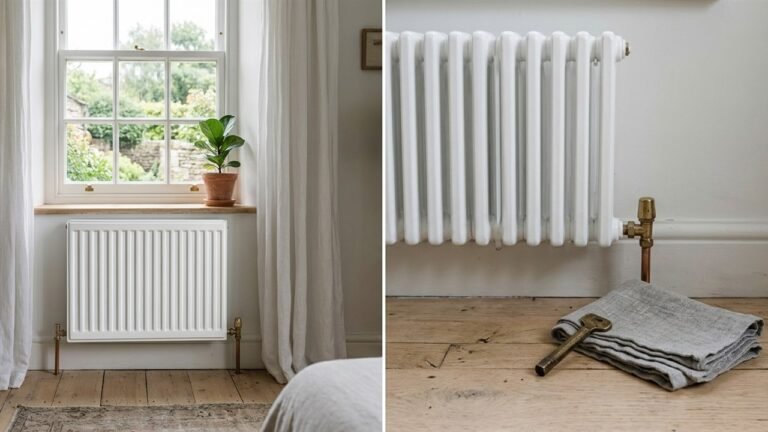
When water circulates at 60°C instead of 80°C, every square centimetre of radiator surface area matters. If the top third of your upstairs radiators is full of air, or the hallway radiator hogs all the hot flow while the back bedroom barely warms up, the system will feel sluggish. Spend fifteen minutes working through our guide on how to bleed and balance UK radiators so every room gets an even share of heat.
2. Heating Schedule Needs a 15-Minute Head Start
At 60°C, radiators emit gentler, steadier warmth rather than scorching blasts. Bring your morning and evening timer slots forward by 15 to 20 minutes. Even though the boiler runs slightly longer during warm-up, it burns less total gas because it modulates down and stays in condensing mode. If you are weighing up timed bursts versus steady background warmth, see our breakdown of whether it is cheaper to leave heating on low all day in the UK.
3. Draughts Undoing Your Boiler’s Efficiency
Radiators running at 60°C output roughly 25% to 30% fewer watts than at 75°C. In a draughty period property, cold air pouring through an unsealed letterbox, sash window gap, or bare floorboards can outpace a single-panel radiator during a cold snap. Tackling the worst heat leaks with cheap ways to draught-proof a cold UK flat under £30 often unlocks the extra thermal margin needed to run at 55°C–60°C all winter.
4. Freezing Cold Snaps (-2°C or Below)
There is nothing wrong with seasonal tweaking. Keep your combi at 55°C in October, November, March, and April; sit at 60°C through December, January, and February; and if Britain gets a week-long Arctic blast at -3°C and the house feels sluggish, nudge it up to 65°C for those few days before dropping it back down. Better still, ask your Gas Safe engineer at your next annual service whether your boiler supports weather compensation — an inexpensive £40–£90 outdoor sensor that adjusts flow temperature automatically according to the outside air temperature. Make sure you also review our UK winter home maintenance checklist before the coldest months hit.
Can You Go Even Lower Than 60°C?
Yes — if your home holds heat well and has double-panel convector radiators (Type 22 radiators with fins inside), you can test 55°C or even 50°C during mild British winters (when outdoor temperatures hover around 6°C to 11°C). Remember that UK radiators were historically oversized by plumbers using rough rules of thumb, especially in homes that have since had double glazing, cavity wall insulation, or loft insulation added.
The test is straightforward: drop to 55°C for three days. If your rooms still reach your normal thermostat setting within 45 to 60 minutes, you have found free extra efficiency. Property construction plays a clear role here: a modern cavity-wall semi-detached house or post-2000 purpose-built London flat with double glazing often sails through November and March at 52°C–55°C, whereas a 1900s solid-brick Victorian terrace with tall ceilings and bay windows usually performs best at 60°C through winter and 65°C during sub-zero January frosts. If the boiler stays running non-stop all evening without reaching the target room temperature, bump back up by 5°C.
Frequently Asked Questions
Will lowering my combi boiler to 60°C make my showers colder?
No. On a combi boiler, the central heating flow temperature (radiator icon) and domestic hot water temperature (tap icon) are controlled independently. Lowering the radiator flow temperature to 60°C has zero effect on how hot your shower or kitchen taps get.
Does running a boiler at 60°C damage it or cause sludge?
Quite the opposite. Running a condensing boiler at 60°C reduces extreme thermal expansion inside the heat exchanger and cuts down on short-cycling, which reduces wear on the fan, spark electrode, and gas valve. Sludge is caused by oxygen corroding steel radiators when chemical inhibitor is missing, not by lower flow temperatures.
What if I have a Hive, Nest, or Tado smart thermostat?
Most standard UK smart thermostats (including standard Hive and basic on/off Nest setups) only turn the boiler on and off — they do not change the boiler’s flow temperature, so you still need to lower the boiler’s own dial to 60°C. The exception is if your thermostat is wired via OpenTherm or a manufacturer modulating control (such as Tado EU, Vaillant sensoHOME, or Worcester Bosch EasyControl), which dynamically lowers the flow temperature automatically.
Why does my boiler say “Eco” on the dial — is that 60°C?
Not always. On several popular UK boilers (including older Worcester Bosch and Ideal models), the “e” or Eco mark on the heating dial corresponds to around 65°C to 68°C rather than 60°C. Checking your model’s user manual — or setting just below the “e” mark on an analogue dial — ensures you actually get the return water below the 55°C condensing threshold.
Should I change my boiler flow temperature if I have a heat pump?
No — air-source heat pumps operate completely differently and are already designed to run at much lower flow temperatures (typically 35°C to 45°C via weather compensation). Turning a heat pump up to 60°C would drastically increase your electricity bills rather than reduce them.
Should I also turn off my combi boiler’s “Pre-Heat” or “Comfort” mode?
Yes, in most UK homes. Combi boiler “Pre-Heat” (sometimes labelled Comfort or Eco-Off on Worcester Bosch, Vaillant, and Ideal boilers) periodically fires the burner throughout the day and night just to keep a tiny internal mini-store of water warm so your kitchen tap runs hot five seconds faster. Turning Pre-Heat off (or pressing Eco ON) saves roughly £30 to £60 a year in wasted gas with barely any noticeable delay at the tap.
Does lowering flow temperature work on an older pre-2005 non-condensing boiler?
No — and you should not drop a pre-2005 non-condensing boiler below 65°C. Non-condensing boilers lack stainless-steel or aluminium-silicon condensing heat exchangers and condensate drains; forcing flue gases to condense inside an old non-condensing cast-iron boiler causes acidic condensation that corrodes the heat exchanger and flue liner. If your boiler has no white plastic condensate pipe and is over 20 years old, leave the flow temperature at 65°C to 75°C and consult a Gas Safe engineer about an eventual upgrade.
About Harry Bennett
Harry is the editorial lead at London Homecare, researching practical home maintenance, damp prevention, laundry care, and energy-saving solutions tailored to UK flats, terraced houses, and British weather conditions.