
Why Your Washing Machine Smells Like Mould (And the 60°C Deep-Clean Fix)
 By Harry Bennett
•
•
15 min read
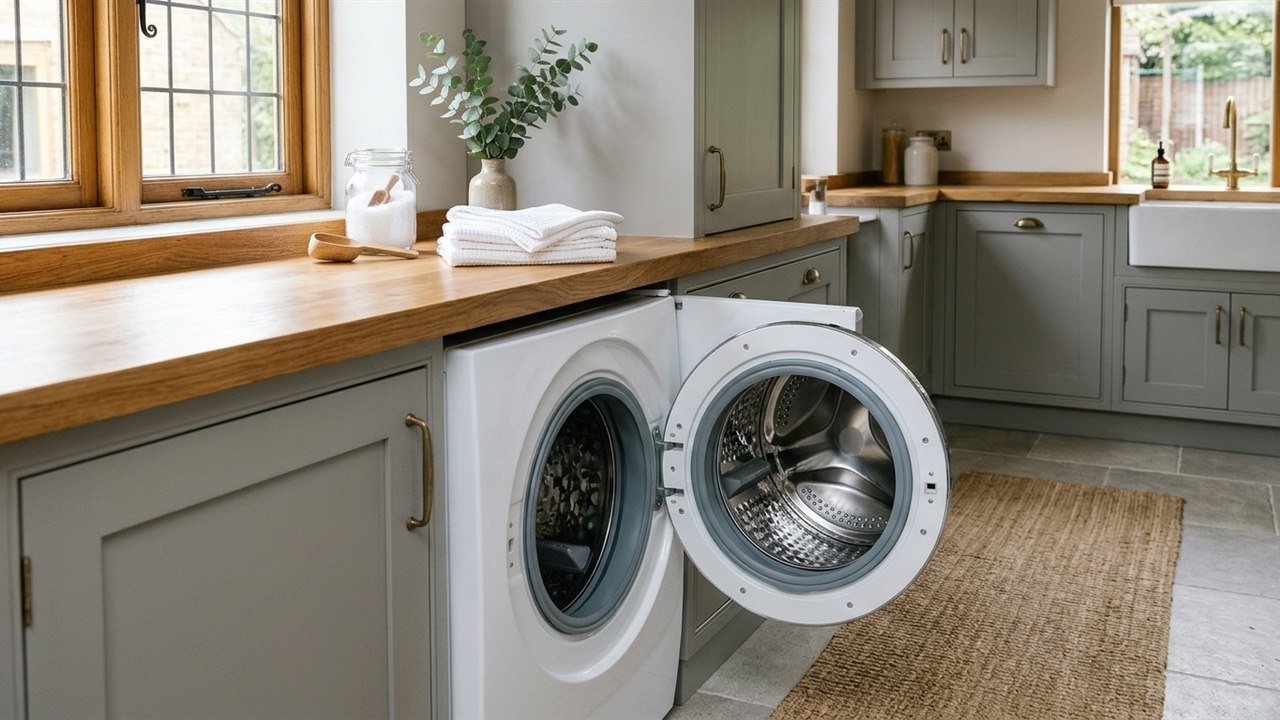
Open your washing machine door in a British flat and catch a whiff of stagnant pond water or damp cellar—even though you use branded scented pods? You are dealing with microbial biofilm (often called “scrud”), a grey, greasy sludge of undissolved detergent, fabric conditioner wax, skin oils and mould spores clinging invisibly behind the stainless steel drum.
Scent boosters only mask the stench for an hour. To eliminate washing machine odour permanently, you need to physically clear the three hidden sludge traps—the detergent drawer cavity, the rubber door seal and the lower pump filter—and then run an empty 60°C (or 90°C) maintenance wash with soda crystals or an oxygen-based machine cleaner.
Quick Answer & Key Takeaways
- Why machines smell: Repeated 20°C–30°C eco cycles never melt fatty fabric softener waxes or kill odour bacteria, especially when the door stays shut between washes.
- Best DIY deep-clean agent: 500g of plain soda crystals (around £1.00 per clean) on an empty 60°C or 90°C cotton cycle cuts greasy biofilm and softens hard water safely without damaging rubber seals.
- London & hard-water bonus step: Run a separate 60°C cycle with 150g of food-grade citric acid every 3 months to strip chalky limescale off the heating element—never mix citric acid and soda crystals in the same wash.
- Energy cost reality: One empty 60°C cotton maintenance cycle uses roughly 1.1 to 1.4 kWh, costing around 29p to 37p at typical 2026 UK electricity rates (~26p/kWh).
- Golden prevention habit: Leave both the door and the detergent drawer propped slightly open after every wash, switch to biological powder for towels, and run at least one 60°C bedding or towel load every fortnight.
Why UK Washing Machines Smell Like Mould (30°C Washes, Fabric Softener & Hard Water)
Modern UK front-loading washing machines are engineered to slash water and electricity consumption, yet those same eco improvements create ideal breeding conditions for mould and bacteria. Most British households now wash almost everything at 30°C or on cold “Eco 40–60” programmes to keep energy bills down—a sensible strategy for everyday clothes, as we examine in our breakdown of the best washing temperatures for UK energy bills, but one with an unseen side effect inside the machine.
At 30°C, modern liquid detergents and gel capsules clean fabrics adequately, yet cool water fails to melt heavy waxy esters found in liquid fabric conditioners, body sebum, cooking grease and skin cells. Rather than flushing cleanly down the waste pipe, that sticky residue settles in the narrow dark gap between the spinning inner stainless drum and the stationary outer plastic tub, around the rubber bellows seal, and inside the roof of the dispenser compartment.
Geography makes the problem noticeably faster in southern and eastern England. Across London, Kent, Surrey, Essex, Hertfordshire and East Anglia—where Thames Water and regional suppliers deliver very hard water at 250 to 330 mg/L of calcium carbonate—dissolved minerals bind directly with liquid soap surfactants to form stubborn, waxy calcium soap scum. That rough mineral crust coats the concealed heating element and the aluminium spider arm behind the drum, acting like Velcro for black mould spores and foul-smelling bacteria. Households in naturally soft-water regions such as Scotland, Wales, Cornwall and the North West escape heavy limescale, yet still suffer severe bacterial biofilm if they overdose liquid detergent or shut the door tightly straight after unloading.
If your kettle already furrs up every few weeks—see our guide to descaling a kettle in London’s hard water—assume the exact same chalky minerals are quietly coating your washing machine’s internal heater and trapping smelly sludge behind the drum.
Washing Machine Cleaners Compared: Soda Crystals vs Citric Acid vs Branded Liquids
Walk down any UK supermarket laundry aisle and you will see £4 single-use bottles promising instant hygiene alongside £2 bags of traditional soda crystals. Different products solve different chemical problems—grease requires an alkali, limescale requires a mild acid, and live mould bacteria require heat plus oxygen bleach.
| Cleaning Agent | Typical UK Retail Price | Cost per Clean | Removes Grease & Biofilm? | Removes Limescale? | Safe for Rubber Seals & Drum? | Best Use Case |
|---|---|---|---|---|---|---|
| Soda crystals (e.g. Dri-Pak 1kg bag, 500g dose) | £2.00–£2.50 per 1kg | £1.00–£1.25 | Excellent (alkaline degreaser) | Softens water; mild only | Yes—safe for seals & hoses | Primary monthly/quarterly 60°C–90°C sludge clear-out |
| Food-grade citric acid (150g dose at 60°C) | £3.50–£4.50 per 500g | £1.05–£1.35 | No | Excellent | Yes when rinsed well | Quarterly hard-water descaling in London & South East |
| Biological washing powder with oxygen bleach (1 full scoop at 60°C) | £4.50–£7.00 per box | £0.20–£0.35 | Very good | Mild | Yes (designed for machines) | Cheap monthly odour & bacteria sanitising wash |
| Branded liquid machine cleaners (Dettol / Dr. Beckmann Service-It) | £3.50–£5.00 per bottle | £3.50–£5.00 | Good | Moderate (citric/lactic acid) | Yes | Convenient all-in-one refresh for rental move-ins |
| Clear distilled white vinegar (500ml) | £0.65–£1.20 | £0.65–£1.20 | Poor | Moderate | Caution: frequent use softens rubber seals | Occasional light wipe-down only; not for routine drum washes |
| Household chlorine bleach | £0.70–£1.50 | £0.15–£0.30 | No (bleaches colour only) | No | No—corrodes steel, spider arm & rubber | Avoid pouring directly into UK washing machines |
Notice why many major manufacturers—including Bosch, Siemens, Miele and Hotpoint—caution against routinely pouring litres of neat white vinegar into the drum. Over time, concentrated acetic acid swells and perishes EPDM rubber door gaskets and internal pump hoses. Plain soda crystals for greasy biofilm, paired with a separate quarterly citric acid descale in hard-water areas, delivers better results at a quarter of the price of branded bottles.
Step-by-Step: The Complete 60°C Washing Machine Deep-Clean Fix
Running a hot wash alone will not fix a smelly machine if thick black gunk is still wedged inside the drawer housing and coin trap. Set aside 30 minutes of hands-on prep before pressing start on the hot cycle.
- Gather your kit and check the drum is empty: You will need rubber gloves, two old towels, a shallow roasting tin or baking tray, an old toothbrush, warm washing-up liquid, microfibre cloths and 500g of soda crystals (or a branded cleaner). Double-check no stray socks remain inside the drum.
- Remove and scrub the detergent drawer and its ceiling cavity: Pull the drawer out fully, press the central release tab, and slide it free. Soak it in hot washing-up liquid water for 10 minutes, unclipping the fabric-softener siphon cap to clear pink slime. Shine a torch inside the empty housing and scrub the plastic roof water jets with a warm soapy toothbrush—black mould thrives there—before wiping loose flakes out with kitchen roll.
- Deep-clean the rubber door gasket folds and drain holes: Peel back the inner lip of the grey rubber bellows all around the rim. Scoop trapped hair, lint and pooled sludge from the bottom fold using kitchen roll, then wipe deeply with hot soapy water on a microfibre cloth. Clear the two or three small drainage holes at the 6 o’clock base gently with a cotton bud so rinse water drains freely.
- Drain and clear the bottom-front pump filter (coin trap): Open the lower kickplate flap (unclipping the plinth on integrated kitchen machines), lay down old towels, and tuck a shallow roasting tin underneath. Drain any emergency rubber tube into a jug first, then unscrew the round filter cap slowly anticlockwise a quarter-turn at a time to catch the 1 to 1.5 litres of foul grey water safely. Rinse off hairpins, fluff and slime, wipe carefully inside the housing (watching for glass shards), and tighten firmly clockwise.
- Inspect the kitchen waste trap and drain hose connection: If the odour smells specifically like rotten eggs or sewage rather than earthy mould, glance under your kitchen sink. The grey washing machine drain hose should loop upward into a high arc (at least 60cm off the floor) before joining the sink spigot above the U-bend water seal. If the hose droops flat below the sink trap, smelly dirty washing-up water back-siphons straight into your washing machine drum.
- Run the empty 60°C (or 90°C) deep-clean cycle: Pour 500g of plain soda crystals directly into the empty stainless steel drum (not the detergent drawer, where clumps can block narrow pipes). Select your machine’s dedicated “Drum Clean” cycle—or a standard 60°C Cottons cycle (avoid “Eco” modes, which artificially lower peak water temperature to save energy). If the machine has not been cleaned in over a year and smells heavily of mould, use a 90°C Cottons cycle for this first reset.
- Run a separate hard-water citric acid descale (London & South East): If you live in a hard-water postcode, wait until the soda-crystal wash finishes, then run a second empty 60°C cycle with 150g of food-grade citric acid tipped into the drum. Splitting grease removal (alkaline) and limescale removal (acidic) into separate cycles lets each chemical work at full strength.
- Wipe the glass door and air the drum completely: Once finished, wipe the inside of the glass door, dry the rubber bellows fold with a clean tea towel, and leave both the main door and the detergent drawer ajar by a few inches so warm moisture evaporates rapidly.
Crucial programme warning: Never select “Eco 40–60” when running a maintenance clean. Under UK and EU energy labelling rules, an Eco 40–60 cycle often heats water to only 35°C–42°C for extended soaking rather than reaching true 60°C—which is too cool to break down thick waxy biofilm or kill odour-causing fungi.
Stubborn Black Mould on the Rubber Seal & Washer-Dryer Odours
Two common London flat scenarios need slightly different treatment beyond a standard 60°C drum wash: permanently speckled door gaskets and all-in-one washer-dryer machines.
Black Mould Stains Embedded in the Rubber Door Gasket
Surface slime wipes off cleanly during Step 3, yet neglected seals often retain dark ink-black blotches. Once mould hyphae grow microscopically into porous EPDM rubber, even after the spores are completely dead and sanitised, the dark pigment stays permanently dyed into the rubber. You can lighten moderate spotting safely by pressing kitchen roll dampened with an oxygen-bleach solution (dissolved sodium percarbonate—never harsh chlorine bleach, which weakens the rubber) against the fold for 45 minutes before rinsing thoroughly. If the rubber is cracked, gummy or still smells sour after thorough cleaning, replacing the door gasket is the only permanent cure. Replacement seals cost £25 to £55 online by model number, or £95 to £160 fitted by a local UK appliance engineer.
Why Integrated Washer-Dryers Smell Worse in Small UK Flats
Many London flats lack space for a separate tumble dryer and rely on condenser washer-dryers. Because washer-dryers rarely have a removable fluff filter, wet cotton lint gets baked inside the internal condenser duct and mixes with soapy steam—creating a sweet, burnt-musty odour that transfers straight onto bath towels. Run a short 10-minute rinse-and-spin cycle after every heavy towel drying session to flush damp lint from the seal, and check whether your machine has a built-in “Fluff Clean” or “Air Wash” programme. If towels still emerge smelling sour even from a spotless machine, the bacteria are embedded inside the terry loops themselves—follow our dedicated guide on how to stop towels smelling musty in the UK.
Safety Warning & UK Tenant / Landlord Maintenance Note
- Never mix chlorine bleach with white vinegar, citric acid or descalers: Combining household bleach with any acid immediately generates hazardous chlorine gas, which causes acute breathing and eye irritation—especially in compact windowless utility cupboards or galley kitchens.
- Never combine soda crystals and citric acid in the same wash: Soda crystals are strongly alkaline and citric acid is acidic; putting both in together causes them to neutralise each other into ineffective salty water. Always run them in separate cycles.
- Unplug before pulling integrated machines forward: If you need to inspect the rear drain hose or check for damp behind an under-counter machine, switch off the wall isolation switch first and watch out for taut water inlet pipes that can snap if yanked.
- Upper-floor flat flood caution: Before unscrewing the lower pump filter in an upstairs flat, have two thick towels and a wide shallow tray ready—a blocked pump can hold 2 to 3 litres of water ready to surge through floorboards into your downstairs neighbour’s ceiling.
- UK tenant vs landlord responsibility: Cleaning the detergent drawer, wiping the rubber door seal and clearing coins or fluff from the front pump filter count as normal tenant upkeep. However, if a landlord-supplied machine leaks from a perished gasket, refuses to heat to 60°C (dead heater element), or drains slowly due to an internal pump or plumbed waste-pipe fault, report it in writing to your landlord or letting agent rather than attempting internal electrical disassembly.
Component-by-Component Safety Guide: What Damages UK Washing Machines
Social-media “hacks” frequently recommend pouring harsh bathroom cleaners, neat bleach or dishwasher tablets into washing machines. Understanding the materials hidden inside your appliance shows why gentler chemistry lasts far longer.
The Aluminium Drum Spider Arm
Behind your gleaming stainless steel inner drum sits a three-pronged cast-aluminium support bracket called the spider arm. It is the Achilles’ heel of most mid-range UK washing machines. Caustic drain unblockers, neat chlorine bleach and heavily acidic concoctions accelerate galvanic corrosion on raw aluminium, eventually causing the arm to rot and snap mid-spin—an uneconomical £200+ repair. Moderate soda crystals and occasional properly diluted citric acid rinsed cleanly at 60°C protect this component far better.
EPDM Rubber Door Bellows & Internal Silicone Hoses
Repeatedly dumping half a litre of neat white vinegar or chlorine bleach into the drum dries out plasticisers in rubber hoses and makes the grey door gasket brittle, tacky or prone to weeping leaks during high-speed 1,400rpm spins. Stick to warm soapy water for manual wiping and oxygen bleach or soda crystals for drum washes.
Stainless Steel Drum, Painted Steel Casing & Plastic Dispenser
Never scrub exterior white enamelled panels or brushed-chrome control dials with green scouring pads or gritty cream cleaners, which strip gloss and leave rust-prone scratches. Wipe external splashes with a soft microfibre cloth and plain warm water, and keep abrasive powders away from glossy acrylic door windows.
Copper-Alloy Heating Element & Thermistor
In hard-water areas like London, thick limescale encasing the submerged heater forces it to run hotter and trip error codes (such as Hotpoint F08 or Bosch E19). A quarterly 60°C wash with 150g of food-grade citric acid dissolves mineral crust gently without pitting the metal sheath.
6 Everyday Laundry Mistakes That Bring Mould Smells Back
- Shutting the door tight immediately after unloading: Sealing warm, humid air inside a dark drum creates a tropical greenhouse for mildew within hours. Leave the door ajar by 5cm and slide the detergent drawer out slightly overnight.
- Overdosing liquid detergent or doubling up pods: Excess un-rinsed surfactant coats the outer tub in sticky food for bacteria. Measure strictly using the cap’s dosing lines adjusted for your regional water hardness and actual load weight.
- Using thick liquid fabric conditioner on every load: Fabric softener is the number-one contributor to grey slimy scrud. Cut it out completely on towels, microfibre cloths and sportswear (it ruins absorbency anyway), and halve the dose on everyday cottons.
- Running exclusively 20°C–30°C liquid washes for months on end: Liquid detergents contain no oxygen bleaching agents. Mixing in at least one 60°C wash with biological powder (which contains sodium percarbonate) every fortnight naturally sanitises the drum while cleaning your bedding and towels—zero wasted empty cycles.
- Leaving damp laundry sitting inside overnight: Even eight hours in a closed wet drum lets bacteria multiply rapidly, transferring an instant sour odour back into the rubber seal.
- Ignoring slow indoor drying damp: Pulling spotless clothes from a freshly cleaned machine and draping them over cold bedrooms with shut windows makes laundry smell musty all over again. Pair machine hygiene with smart airflow using our guide on how to dry clothes indoors without causing damp.
Preventative Maintenance Schedule & DIY vs UK Engineer Cost Breakdown
Ten minutes of routine upkeep every month prevents foul laundry odours, avoids flooded kitchen floors and easily adds three to five years to a washing machine’s lifespan—saving hundreds of pounds in avoidable call-out fees.
| Maintenance Task / Repair | Recommended Frequency | DIY Cost (UK £) | UK Professional Engineer Cost | What It Prevents |
|---|---|---|---|---|
| Wipe rubber door seal & leave door/drawer ajar | After every wash (30 seconds) | £0.00 | N/A | Standing water, mould spotting & stale drum smell |
| Scrub detergent drawer & ceiling jets | Monthly | ~£0.10 (soap) | N/A | Black mould streaks & blocked softener siphon |
| 60°C maintenance wash (500g soda crystals) | Every 1–2 months (if mostly washing at 30°C) | £1.30–£1.60 (inc. electric) | N/A | Greasy biofilm build-up & bacterial odour |
| Clean lower pump filter / coin trap | Every 2–3 months | £0.00 | £75–£120 call-out if pump jams | Drainage error codes, standing water & pump burnout |
| 60°C hard-water descale (150g citric acid) | Quarterly (London/SE); Annually (soft water) | £1.35–£1.70 (inc. electric) | £110–£180 heater replacement | Scale-insulated heater & sluggish heating |
| Replace mould-perished rubber door gasket | Only if torn, leaking or deeply rotted | £25–£55 part (moderate DIY) | £95–£160 parts & labour | Door leaks & persistent embedded rubber odour |
If your household already washes cotton bedsheets, tea towels or white bath towels at 60°C using biological washing powder once a fortnight, your machine stays naturally sanitised and you only need a dedicated empty soda-crystal or citric-acid wash once a quarter.
Frequently Asked Questions
How much does an empty 60°C washing machine clean cost in UK electricity?
A standard 60°C Cottons cycle on an empty 7kg to 9kg UK washing machine typically draws 1.1 to 1.4 kWh of electricity—mostly during the initial 20-minute water heating phase. At a typical 2026 standard variable rate of around 26p/kWh, a single maintenance wash costs roughly 29p to 37p in electricity, or around £1.50 total including 500g of soda crystals.
Should I clean my washing machine with white vinegar and bicarbonate of soda together?
No. Combining an acid (white vinegar) with an alkali (bicarbonate of soda) triggers a dramatic fizzing reaction that neutralises both ingredients into weak salty water and carbon dioxide—leaving you with very little cleaning power. Use plain soda crystals for greasy biofilm and a separate quarterly citric acid wash for limescale instead.
Can I put dishwasher tablets in my washing machine to clean it?
Most UK appliance manufacturers advise against it. Dishwasher tablets are formulated with high-alkalinity caustic salts and anti-corrosion silicates designed for static stainless steel dishwashers, not front-loading washing machines with submerged rubber bellows and cast-aluminium drum spiders. They can also foam excessively and damage electronic foam sensors. Plain soda crystals or a £3.50 dedicated machine cleaner are safer and cheaper.
Why does my washing machine smell like rotten eggs or drains?
A sharp sulphur or sewage smell almost always points to stagnant trapped water rather than simple detergent residue. Check two spots first: unscrew and empty the lower front pump filter (rotting lint and food bits smell awful), and verify that the grey drain hose under your kitchen sink loops high above the U-bend trap so sink waste cannot siphon backward into the drum.
Why do my clothes still smell damp after I deep-cleaned the washing machine?
Once odour-causing bacteria settle deeply into thick cotton towels, gym synthetic fabrics or bedding, ordinary 30°C washes simply reactivate the smell as soon as the fabric gets damp again. Strip affected towels on a 60°C wash using biological powder with zero fabric conditioner, and ensure washed loads come straight out of the drum and dry promptly in a well-ventilated room.
Is black staining on the rubber door seal still dangerous after cleaning?
Usually no. Once you have scrubbed off all surface biofilm and completed a 60°C sanitising cycle, faint dark shadows remaining inside the EPDM rubber are typically dead pigment stains rather than active growing mould colonies. Keep the fold wiped dry after every load; only replace the gasket if the surface feels slimy again quickly, smells sour close up, or develops splits.
Does hard water in London really make washing machines smell worse?
Yes. Very hard water (250–330 mg/L of calcium carbonate across London and the South East) reacts with liquid detergent and skin oils to deposit rough, waxy soap scum and limescale across hidden internal drums and heaters. That porous mineral coating traps far more bacterial biofilm than smooth metal in soft-water parts of Scotland or Wales, making quarterly descaling essential.
About Harry Bennett
Harry is the editorial lead at London Homecare, researching practical home maintenance, damp prevention, laundry care, and energy-saving solutions tailored to UK flats, terraced houses, and British weather conditions.