Heated Airer vs Tumble Dryer vs Dehumidifier: Cheapest Way to Dry Clothes in the UK
 By Harry Bennett
•
•
15 min read
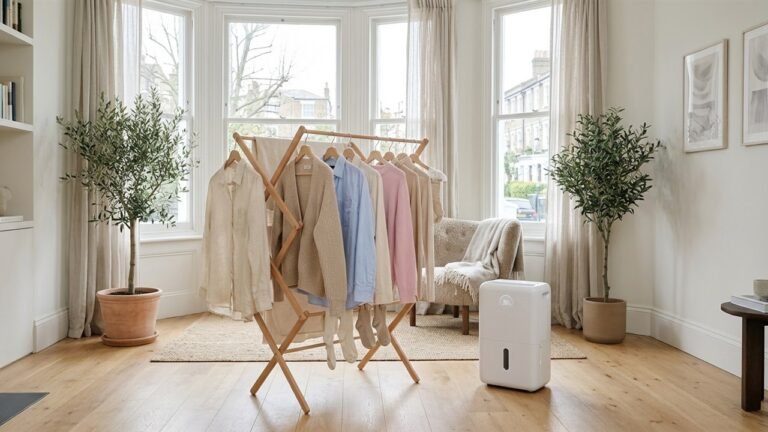
If you dry four loads of laundry every week through a British winter, choosing the wrong drying appliance can quietly add over £150 a year to your electricity bill. Based on an illustrative UK Ofgem electricity unit rate of 25p per kWh, a 12L–20L compressor dehumidifier paired with a standard folding airer is the cheapest electric way to dry clothes indoors at roughly 30p to 45p per 6 kg load, closely followed by an A++ heat-pump tumble dryer at 40p to 55p. Heated airers look cheap per hour at around 7.5p, yet because they need 7 to 10 hours for thick cottons, they often cost more per load than either option — while older condenser and vented tumble dryers remain the priciest at £1.00 to £1.20 a cycle.
Key Takeaways: Cheapest Way to Dry Clothes in the UK
- Lowest running cost overall: A 12L–20L compressor dehumidifier in laundry mode (approx. 200W–260W) dries a 6 kg load in 5–7 hours for 30p–45p and removes 2+ litres of moisture from your flat.
- Best for families washing daily: An A++ or A+++ heat-pump tumble dryer costs 40p–55p per load, finishes in 2–3 hours, and pays back its higher purchase price within 2–3 years compared with a B-rated condenser dryer.
- The heated airer trap: A 300W heated airer costs just 7.5p per hour, but running it for 8–10 hours costs 60p–75p per load — and still releases all that dampness into your room unless paired with ventilation or a dehumidifier.
- Most expensive option to run: B-rated condenser dryers and washer-dryer combos cost £1.00–£1.25 per cycle (plus cold mains water on most washer-dryers), adding £200+ annually for a typical family.
- Hidden money saver: Running a 10-minute 1,400–1,600 rpm extra spin cycle costs just 2p–3p and cuts electric drying bills by 20%–30% across every appliance type.
UK Laundry Drying Cost Comparison: Per Load, Annual & 5-Year Total
Hourly pence figures frequently mislead British shoppers. A heated airer advertises “pennies an hour”, while a heat-pump tumble dryer sounds intimidating because it draws 700W to 900W when its compressor runs. What actually shows up on your smart meter is total kilowatt-hours (kWh) per finished load — wattage multiplied by how many hours the machine stays on — plus the upfront cost of buying the appliance.
The table below compares real-world UK running costs for drying a standard 6 kg cotton washload (spun at 1,400 rpm) at an illustrative unit rate of 25p per kWh, alongside typical annual bills for 200 loads a year (roughly four washes per week) and five-year total ownership cost.
| Drying Appliance | Typical Power Draw | Time per 6 kg Load | Energy Used (kWh) | Cost per Load (at 25p/kWh) | Annual Cost (200 Loads) | Typical UK Purchase Price | 5-Year Total Cost |
|---|---|---|---|---|---|---|---|
| 12L–20L Compressor Dehumidifier + Airer | 200W–260W | 5–7 hours | 1.2–1.8 kWh | £0.30–£0.45 | £75 | £160–£250 | £535–£625 |
| Heat-Pump Tumble Dryer (A++ / A+++) | 700W–900W (cycles) | 2–3 hours | 1.6–2.2 kWh | £0.40–£0.55 | £95 | £420–£650 | £895–£1,125 |
| Heated Airer with Cover (300W, 3-tier) | 300W | 7–10 hours | 2.1–3.0 kWh | £0.53–£0.75 | £128 | £90–£170 | £730–£810 |
| Heated Airer + Dehumidifier Combined | 520W combined | 3.5–4.5 hours | 1.8–2.3 kWh | £0.46–£0.59 | £105 | £250–£420 | £775–£945 |
| Vented Tumble Dryer (C-rated) | 2,200W–2,500W | 1.5–2 hours | 4.0–4.5 kWh | £1.00–£1.13 | £213 | £210–£300 | £1,275–£1,365 |
| Condenser Tumble Dryer (B-rated) | 2,300W–2,600W | 1.5–2 hours | 4.2–4.8 kWh | £1.05–£1.20 | £225 | £250–£380 | £1,375–£1,505 |
| Washer-Dryer Combo (Drying Cycle Only) | 2,000W–2,400W | 2–3 hours | 3.6–4.6 kWh (+ water) | £0.95–£1.25* | £220* | £450–£750 (dual unit) | £1,550–£1,850 |
*Note: Most integrated UK washer-dryers use 30 to 50 litres of cold tap water during the drying phase to cool and condense steam, adding a further 8p to 15p per load on a metered water supply.
Look closely at the five-year column. That “bargain” £250 B-rated condenser tumble dryer ends up costing roughly £400 to £500 more over five years than a £480 heat-pump model — and more than double the five-year cost of running a dehumidifier beside an ordinary £25 airer.
Heated Airers: Honest Pros, Cons and Hidden Costs
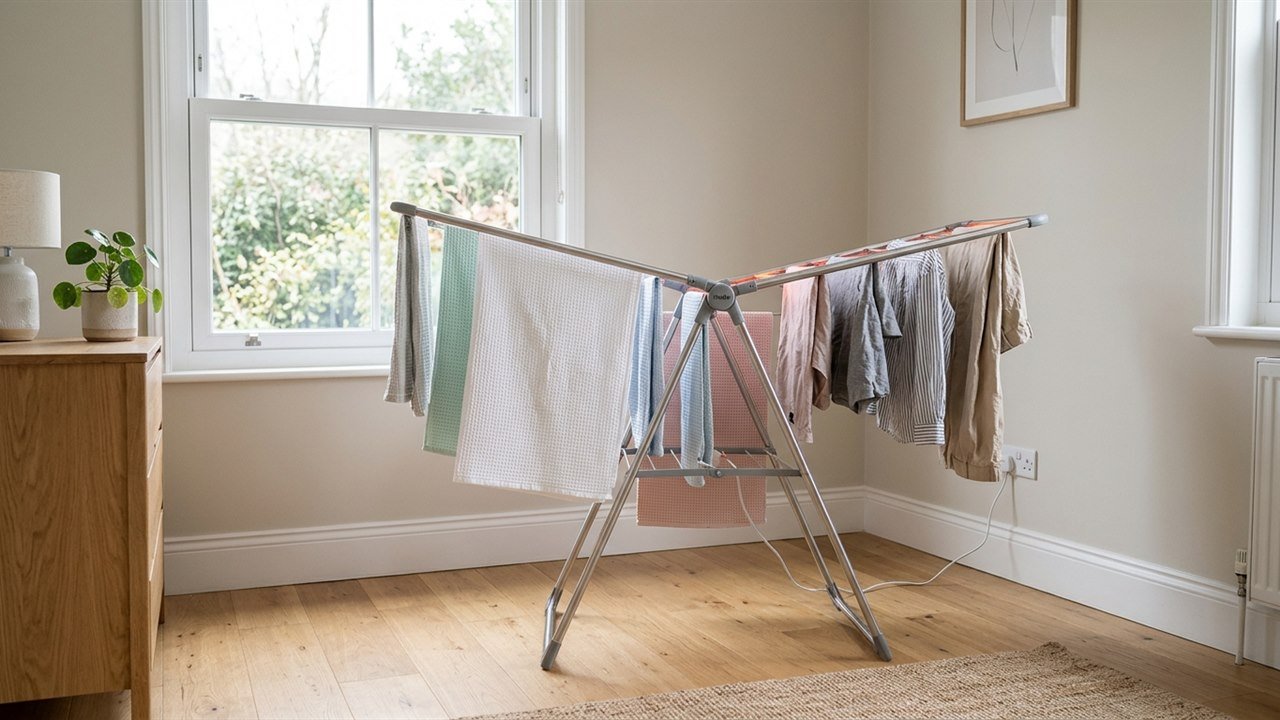
Electric heated clothes airers (from Lakeland’s Dry:Soon range to budget Aldi, Dunelm, and Argos models) surged in popularity during the UK energy crisis. They plug into a standard 13-amp socket, fold flat behind a bedroom door, and require zero plumbing or ducting.
How Much Does a Heated Airer Really Cost to Run?
Most folding wing models draw 220W to 240W (roughly 5.5p to 6p per hour at 25p/kWh), while taller three-tier tower airers draw 300W to 330W (7.5p to 8.3p per hour). On thin gym wear, kids’ uniform polo shirts, and synthetic bedding, a heated airer with a zipped cover finishes in 4 to 5 hours — a very reasonable 30p to 40p.
Where heated airers stumble is dense British winter laundry: heavy denim jeans, fleece hoodies, and thick bath towels. Because the aluminium rungs only heat the narrow strips of fabric directly touching the bars, anything draped unevenly takes 9 to 12 hours unless you rotate items halfway through. At 10 hours on a 300W unit, you have spent 75p — more than a heat-pump dryer — and waited all day.
The Condensation Catch Most Retailers Gloss Over
A heated airer has no water tank and no outdoor vent. Every drop of water evaporated from your wet laundry still enters your flat’s air. Using a heated airer in a small closed bedroom without extraction pushes humidity sharply upward, accelerating condensation on double glazing and behind skirting boards. If your flat already battles damp, read our practical guide on how to dry clothes indoors without causing damp or mould before relying on a heated airer alone.
Compressor Dehumidifiers: Why They Beat Heated Airers in UK Flats
For renters in London, Manchester, or Edinburgh flats without space for a separate tumble dryer, a modern low-wattage compressor dehumidifier (12L or 20L capacity) wins on almost every metric: cost per load, fabric gentleness, damp protection, and year-round usefulness.
Rather than boiling moisture off fabric with high heat, a dehumidifier pulls humid air across refrigerated coils, condenses water vapour into a removable tank, and blows slightly warmed, bone-dry air back through your clothes. Dry air absorbs water rapidly even at modest 17°C–19°C room temperatures. A full 6 kg washload positioned in a small closed room typically dries in 5 to 7 hours using roughly 1.2 to 1.8 kWh (30p to 45p) — and your walls stay completely dry. You can check exact hourly wattages across leading British models in our breakdown of dehumidifier running costs in the UK.
- Zero fabric shrinkage: Delicate wool jumpers, elastane gym kit, and printed cotton tees never shrink or bobble because there is no mechanical tumbling or 70°C drum heat.
- Double duty in winter: On non-laundry days, it protects cold bedrooms from morning window condensation and mould growth.
- Ideal room temperature caveat: Compressor models work best in rooms heated above 15°C. In an unheated porch or freezing utility lean-to below 12°C, choose a desiccant dehumidifier instead (higher running cost at ~9p–15p/hr, yet reliable in near-freezing spaces).
Tumble Dryers Compared: Heat-Pump vs Condenser vs Vented
Nothing matches a tumble dryer for pure speed, softness on bath towels, and removing pet hair from bedding. However, the technology inside the cabinet determines whether your electricity bill stays modest or explodes.
Heat-Pump Tumble Dryers (A++ / A+++)
Heat-pump models recycle warm air in a closed loop using a miniature heat-exchanger circuit rather than burning electricity through a glowing 2.5 kW heating element. They run slightly cooler (around 50°C instead of 75°C), which takes 30 to 45 minutes longer per cycle than an old vented dryer yet cuts electricity consumption by 55% to 65%. At 40p to 55p per load, a household running five loads a week saves roughly £155 to £180 every year compared with a condenser dryer — recouping the extra £200 purchase cost in under 18 months.
Condenser and Vented Dryers (B & C Rated)
Standard condenser dryers (which need no external wall hole) and vented dryers (which blow steam outdoors via a flexible hose) rely on brute-force resistive heater elements. They are cheap to buy upfront (£210–£350), making them tempting for landlords furnishing rentals or buyers on a tight move-in budget. Yet at £1.00 to £1.20 a cycle, they are only financially sensible if you use them sparingly — say once a fortnight for heavy winter duvet covers or emergency school uniform rescues.
How UK Electricity Unit Rates Shift Your Break-Even Point
Because Ofgem adjusts the Great Britain energy price cap every quarter, your exact pence per cycle moves with your tariff. At a 20p/kWh fixed deal, a heat-pump dryer costs 32p–44p per load and a dehumidifier drops to 24p–36p. If electricity rises to 30p/kWh, a B-rated condenser dryer jumps to £1.26–£1.44 per wash — making an A++ heat-pump dryer pay back its higher upfront cost in barely 14 months for busy family homes. Conversely, households on solar-battery systems or daytime off-peak tariffs paying under 12p/kWh see the gap narrow dramatically, letting speed and flat damp-control decide the winner rather than raw electricity bills alone.
If your existing condenser dryer still works well, you do not need to bin it immediately. Reserve it for a 20-minute “fluff and finish” on towels once clothes are 85% dry from an airer or dehumidifier — cutting its bill to under 25p per load.
Step-by-Step: How to Cut Any Drying Bill by 25%–40% Immediately
Whichever drying setup you already own, these six habits slash wasted kWh from your next wash onward:
- Always finish with a high-speed extra spin: Mechanical spinning is roughly 15 times more energy-efficient at removing water than thermal evaporation. Running a 10-minute 1,400–1,600 rpm spin costs 2p–3p and slices 25–45 minutes off tumble dryer cycles or 2 hours off airer drying times.
- Match wash temperatures and laundry habits together: Dropping wash temperatures saves significant electricity on the washing side too — see our exact kWh numbers in 30°C vs 40°C vs 60°C washing machine costs in the UK.
- Clean lint traps and heat-exchanger filters religiously: A lint-clogged filter inside a tumble dryer restricts airflow, forcing cycles to run 30% to 50% longer. Empty the door lint screen after every single cycle and vacuum the lower heat-pump condenser sponge monthly.
- Toss three wool dryer balls into the drum: Reusable New Zealand wool balls (£8–£12) separate clumped sheets and towels, improving hot-air circulation and trimming tumble drying duration by 10% to 20%.
- Use a fitted cover on heated airers — with a small air gap: Leaving a heated airer uncovered lets half its warmth float straight to the ceiling. Zip a dedicated fabric cover over it (leaving a 3 cm bottom gap so damp vapour escapes) to reduce drying time by a third.
- Shift heavy drying to off-peak smart tariffs if available: Households on Economy 7, Octopus Agile, or EV overnight tariffs paying 7p–14p per kWh can halve drying bills — though never run tumble dryers unattended while asleep (use a delay timer set to finish once you are awake at 6:30 am, or run a low-draw dehumidifier during cheaper late-evening slots). You can also audit standby drains across laundry and kitchen appliances in our guide to cutting UK electricity bills from phantom load.
Fabric-by-Fabric Guide: Which Drying Appliance Protects Your Clothes Best?
Electricity pence per load only tells half the financial story. Shrinking a £65 merino knit jumper in a vented dryer or melting elastane fibres in £50 running leggings wipes out a full winter’s energy savings overnight. Use the textile comparison below to match every fabric in your wash basket to the safest and most economical drying method.
| Textile / Garment Type | Best Appliance Choice | Avoid Using | Expected Drying Time | Fabric Longevity Note |
|---|---|---|---|---|
| Egyptian cotton bath towels (500–700 gsm) | Heat-pump tumble dryer (or 20-min finish after airer) | Unassisted heated airer (slow & stiff) | 2–2.5 hrs (heat-pump) / 7–8 hrs (dehumidifier) | Tumbling fluffs cotton loops; skip liquid softener to keep absorbency |
| Denim jeans & heavy cotton hoodies | Compressor dehumidifier + airer | High-heat vented/condenser dryer | 6–7 hrs (dehumidifier) | High heat breaks down stretch-denim elastane and shrinks hems |
| Cotton percale & linen bedsheets | Heat-pump dryer (anti-crease) or pulley airer + dehumidifier | Overloaded heated airer | 1.5–2 hrs (heat-pump) / 4–5 hrs (dehumidifier) | Unbutton duvet covers so socks do not ball inside damp corners |
| Polyester gymwear & Lycra leggings | Unheated airer + dehumidifier or low-bar heated airer | Any tumble dryer above 40°C | 2–3 hours | High heat destroys moisture-wicking coatings and stretches waistbands |
| Microfibre cleaning cloths & tea towels | Airer + dehumidifier (or cool tumble) | Hot condenser dryer / dryer sheets | 2–3 hours | Excess heat melts micro-filaments, permanently reducing grease pickup |
| Wool, cashmere & lambswool knits | Flat mesh drying rack + dehumidifier | All tumble dryers & direct heated bars | 10–14 hours | Lay flat after towel-rolling; hanging wet wool stretches shoulders |
| School uniform shirts & polyester-cotton trousers | Heated airer with cover or dehumidifier on coat hangers | Over-drying in hot condenser drum | 3–4 hours | Drying on coat hangers cuts morning ironing time dramatically |
UK Flat vs House Drying Budgets: Real Seasonal Scenarios
How much will your actual winter bill (October to March — 26 weeks of indoor drying) look like depending on your property type and household size? Here are three realistic British benchmarks at 25p per kWh:
- Scenario 1 — Young couple in a 1-bed London flat (3 loads/week = 78 winter loads): Using a 12L compressor dehumidifier beside a folding tower airer costs roughly £27 to £35 for the entire six-month winter, keeps relative humidity below 55%, and fits neatly into a hallway cupboard. Using a B-rated condenser washer-dryer for those same 78 loads would cost £85 to £98 plus metered water charges.
- Scenario 2 — Family of four in a 3-bed Victorian terrace (6 loads/week = 156 winter loads): Running an A++ heat-pump tumble dryer costs roughly £65 to £85 across winter and clears piles of school uniform, football kit, and bath towels effortlessly. Running an older vented or condenser dryer for 156 loads hits £165 to £187 per winter — a £100+ seasonal leak every single year.
- Scenario 3 — House-share or rented flat on a tight upfront budget (4 loads/week = 104 winter loads): A £100 three-tier heated airer (300W) with a breathable cover costs roughly £60 to £78 across winter if loads are spun at 1,600 rpm first and positioned in a bathroom with the extractor fan on. Adding a £170 dehumidifier later turns it into a hybrid powerhouse that slashes drying times in half.
Practical Troubleshooting: Fixing Slow Cycles & Unexpected Electricity Spikes
If your smart meter shows far higher drying costs than the table above — or clothes still feel clammy after hours of running — one of these common UK household issues is almost certainly to blame:
- Heated airer leaves thick seams wet while strips touching the bars feel bone dry: Aluminium heating rods transfer heat mostly by direct contact. Flip hoodies and jeans inside-out halfway through the cycle, pull thick denim pockets outward, and lay garments flat across two or three rungs rather than hanging vertically in narrow folds.
- Heat-pump tumble dryer suddenly takes 4 hours instead of 2: Nine times out of ten, lint has slipped past the door screen and coated the lower aluminium condenser fins. Vacuum the fins gently with a soft brush attachment (never bend the delicate metal blades) and wash the removable foam plinth filter under lukewarm tap water, letting it dry completely before reinserting.
- Compressor dehumidifier runs continuously without collecting much water: Check room temperature. In an unheated porch, garage, or freezing utility room below 12°C, refrigerant coils frost over and spend half the hour defrosting. Move the setup indoors to a room at 16°C–19°C, or switch to a desiccant dehumidifier for cold spaces.
- Sensor-dry tumble dryer stops while duvet covers are still damp inside: King-size duvet covers twist into tight balls, fooling moisture sensors into reading the dry outer layer as finished. Fasten the poppers or buttons before washing, pause the dryer after 45 minutes to unroll the sheet, and add three wool dryer balls to keep air channels open.
Which Setup Suits Your UK Home Best?
- Small London flat or rented bedsit (1–2 people): A 12L compressor dehumidifier + three-tier folding airer. Lowest running cost, folds away cleanly, zero plumbing, and stops winter mould dead in its tracks.
- Family of four in a terrace or semi (6+ loads/week): An 8 kg or 9 kg A++ heat-pump tumble dryer for bedding, towels, and school uniform, backed up by an unheated airer for delicates.
- Tight upfront budget (under £120) with decent ventilation: A 220W–300W winged or tiered heated airer with cover, placed in a bathroom with the extractor fan running or near an open trickle vent.
- Fastest no-tumble-dryer hybrid: Combine a heated airer + compressor dehumidifier in one shut box room. The airer warms the garments while the dehumidifier strips away the vapour, finishing heavy jeans and hoodies in under 4 hours for around 50p.
UK Electrical & Fire Safety Warning for Drying Appliances
Never run tumble dryers overnight or while out of the house: According to UK Fire and Rescue Services, tumble dryers remain one of the leading causes of accidental white-goods fires due to trapped lint overheating near elements and motors. Always clean lint traps every load, register new appliances on registermyappliance.org.uk for recall alerts, and keep the rear vent clear of clutter.
Direct wall sockets only: Plug tumble dryers, heated airers, and dehumidifiers straight into a fixed wall socket — never daisy-chained multi-way adaptors or coiled extension reels, which can overheat under sustained load. Never drape soaking-wet items over a heated airer’s electrical switch box or power cable.
Frequently Asked Questions
1. Is a heated airer cheaper to run than a tumble dryer in the UK?
A heated airer is cheaper than an older vented or B-rated condenser tumble dryer (around 55p–75p per load versus £1.00–£1.20). However, against a modern A++ heat-pump tumble dryer (40p–55p per load), a heated airer often costs slightly more per full load of heavy cottons because it must stay switched on for 8 to 10 hours.
2. Is a dehumidifier cheaper than a heated airer for drying clothes?
Yes. A 12L or 20L compressor dehumidifier typically draws 200W–260W and dries a 6 kg load in a closed room within 5 to 7 hours (30p–45p at 25p/kWh). A 300W heated airer generally requires 7 to 10 hours (53p–75p) and does not capture the evaporated moisture, leaving your room humid.
3. Can I put a bedsheet over a heated airer instead of buying a cover?
Only if it is a lightweight cotton sheet draped loosely with clear gaps at the bottom and kept completely away from the power switch and cable. Heavy damp duvet covers trap saturated air inside, stopping clothes from drying properly and creating musty smells. Purpose-made breathable zip covers perform noticeably better.
4. Why does my heat-pump tumble dryer take longer than my old vented dryer?
Heat-pump dryers operate at lower drum temperatures (roughly 50°C compared with 75°C in vented machines) so they can recycle heat efficiently and protect fabrics. Although cycles last 2 to 3 hours instead of 90 minutes, the compressor draws far less power, cutting your electricity cost per load by more than half.
5. How much does it cost to run a washer-dryer combo on the dry setting?
Most standard UK condenser washer-dryers cost between 95p and £1.25 per drying load at 25p/kWh, because they use resistive heating elements, have smaller drying drum capacities (often half the wash capacity), and consume 30 to 50 litres of cold mains water to condense steam. Only newer heat-pump washer-dryers drop costs closer to 50p per load.
6. Does using a dehumidifier and heated airer together actually save money?
Surprisingly, yes — compared with running a heated airer alone! Combining a 300W heated airer with a 220W dehumidifier (520W total) cuts drying time from 9 hours down to roughly 3.5 to 4 hours, costing around 46p–55p per load while keeping room walls completely dry and preventing sour laundry smells.
7. Are electric drying pods (DriBUDDI style) worth buying in the UK?
Heated fan drying pods typically draw 1,000W to 1,200W (25p–30p per hour) and need 2 to 3 hours for a smaller 3–4 kg load — costing 50p to 90p per load. They are brilliant for crease-free work shirts on coat hangers, yet they release all moisture into the room and cost more per kilogram of cotton than a compressor dehumidifier or heat-pump dryer.
8. Can I plumb a heat-pump tumble dryer or dehumidifier straight into a drain?
Yes. Almost all modern heat-pump tumble dryers and 12L–20L compressor dehumidifiers sold in the UK include a continuous drainage hose fitting. Routing the hose into an under-sink spigot, utility floor waste, or bath plughole eliminates emptying water tanks altogether — ideal for families drying multiple loads back-to-back.
About Harry Bennett
Harry is the editorial lead at London Homecare, researching practical home maintenance, damp prevention, laundry care, and energy-saving solutions tailored to UK flats, terraced houses, and British weather conditions.