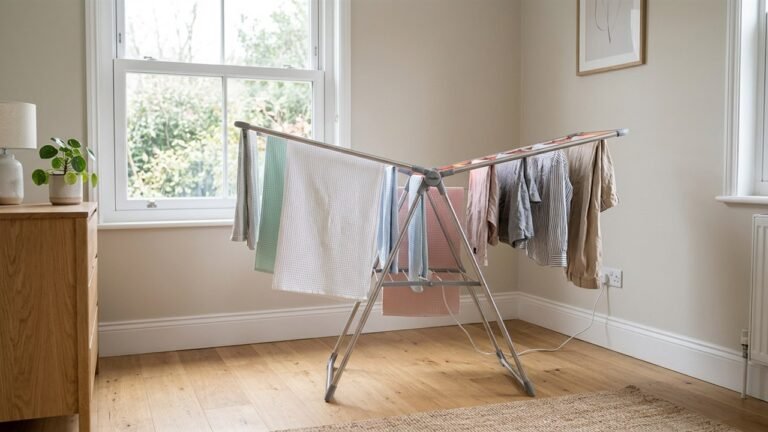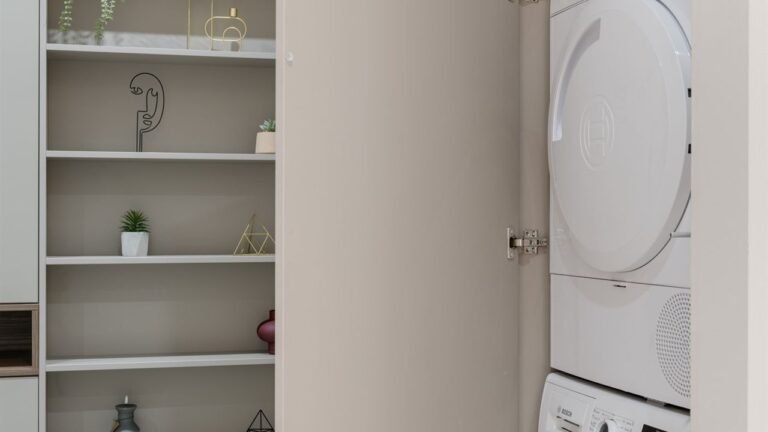
How to Dry Clothes Indoors in Winter Without Causing Damp or Mould in UK Flats
 By Harry Bennett
•
•
16 min read
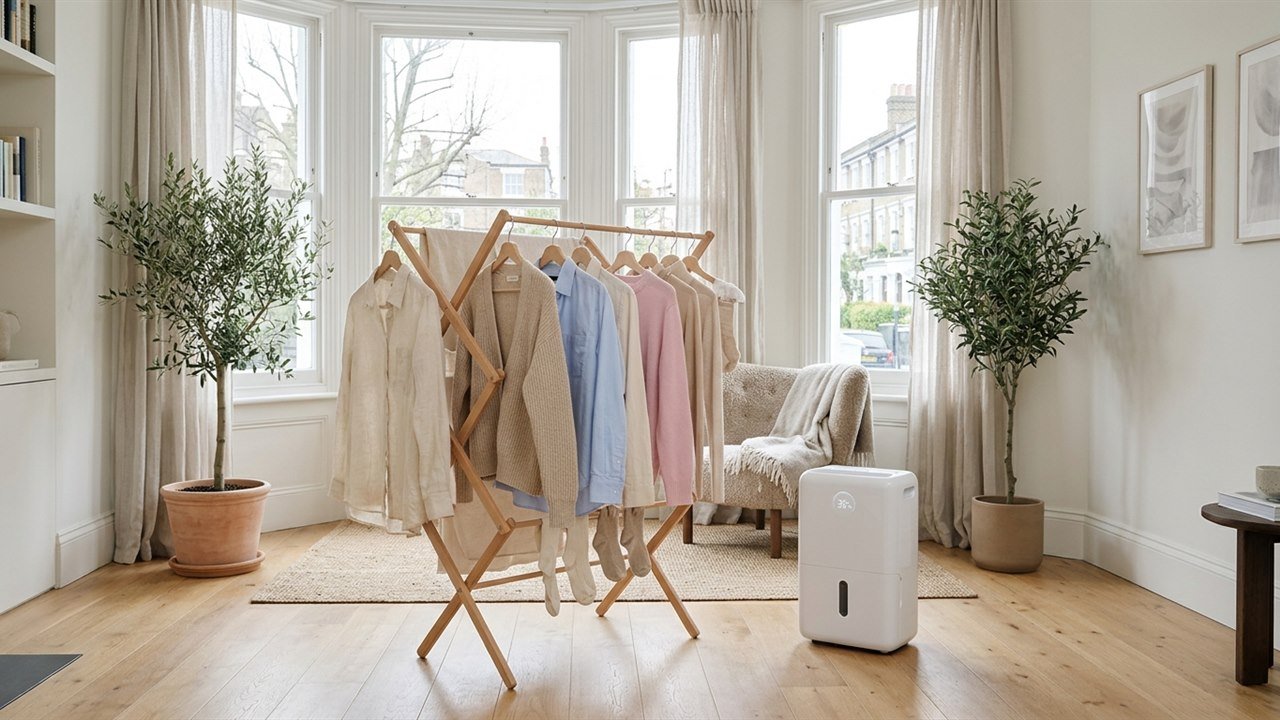
A single 6 kg load of freshly washed laundry holds roughly 2 to 2.5 litres of water after a standard spin cycle — and when you drape it over an airer in a closed London flat, every millilitre evaporates straight into your indoor air. Left unmanaged between October and April, that moisture condenses on cold external walls, window reveals, and behind wardrobes, creating black mould within days. The fix is neither complicated nor expensive: extract more water before hanging, contain the laundry in one closed room, and actively pull moisture out using a dehumidifier or controlled purge ventilation rather than relying on radiators.
Key Takeaways: Drying Clothes Indoors Without Damp
- Run an extra high-speed spin (1,400–1,600 rpm): A 10-minute extra spin costs roughly 2p–3p in electricity and removes up to 30% more trapped water before clothes ever touch the airer.
- Never drape wet clothes directly over radiators: Blocking a radiator forces your boiler to burn more gas while pumping concentrated steam straight onto cold glazing and skirting boards.
- Contain and extract in one room: Shut the door to the drying room and run a 12L–20L compressor dehumidifier (around 5p–7p per hour) or open a window with the extractor fan running in a bathroom.
- Keep indoor relative humidity below 60%: A £10 digital hygrometer tells you instantly whether your flat is drifting into the 65%–75% mould danger zone.
- Space garments properly: Overlapping jeans and hoodies doubles drying times, encourages sour laundry odours, and traps humid pockets against walls.
Why Indoor Drying Causes Damp and Mould So Quickly in UK Flats
Britain’s housing stock makes winter laundry uniquely tricky. Whether you live in a Victorian terrace conversion in Hackney with solid brick walls, a 1960s ex-council flat with thermal bridging around concrete lintels, or a newer airtight block with limited cross-ventilation, indoor air can only hold a finite amount of water vapour before it hits dew point.
At a typical British living-room temperature of 19°C, air holds roughly 16 grams of water vapour per cubic metre at 100% saturation. A modest 12-square-metre bedroom contains around 29 cubic metres of air. Hang one wet washload holding 2,000 grams (2 litres) of water inside that room, and you are releasing over four times the total volume of water vapour the room’s air can comfortably absorb — even if the air started completely dry, which in a UK winter it never does.
Where does that excess moisture go? It travels by vapour pressure towards the coldest surfaces in your home: double-glazed window panes, uninsulated bay window plasterboard, cold external corners behind IKEA wardrobes, and north-facing bedroom ceilings. Once warm, moist air meets a surface cooler than its dew point, invisible vapour turns back into liquid water droplets. That is why mornings after laundry day leave pooling water along windowsills — a classic trigger we explore further in our guide on stopping window condensation in UK winters.
When relative humidity stays above 65% to 70% for more than 24 to 48 hours, airborne fungal spores (present naturally in every home) germinate on damp emulsion paint, wallpaper paste, and silicone sealant. Doing three or four loads of laundry every week from November to March keeps background humidity permanently elevated unless that moisture is physically captured or exhausted outdoors.
UK Indoor Drying Methods Compared: Cost, Speed and Damp Risk
Not every drying method affects your flat’s moisture levels or electricity bill in the same way. The table below compares the six most common winter setups used across UK flats and terraced houses, based on a standard 6 kg mixed cotton washload and an illustrative UK electricity unit rate of 25p per kWh.
| Drying Method | Typical Drying Time (6 kg Load) | Estimated Cost per Load (at 25p/kWh) | Moisture Released into Flat | Damp & Mould Risk |
|---|---|---|---|---|
| Unheated airer in closed room (no extraction) | 24–48 hours | £0.00 | 2.0–2.5 litres | Very High |
| Clothes draped over central heating radiators | 8–14 hours | £0.45–£0.90 (extra gas boiler load) | 2.0–2.5 litres (rapid spike) | Very High |
| Unheated airer + 12L–20L dehumidifier (laundry mode) | 5–8 hours | £0.35–£0.55 | Collected in water tank | Very Low |
| Heated airer with cover (300W) alone | 8–12 hours | £0.60–£0.90 | 2.0–2.5 litres | Moderate–High (needs ventilation) |
| Heated airer + dehumidifier combined | 3.5–5 hours | £0.65–£0.95 | Collected in water tank | Very Low |
| Heat-pump tumble dryer (A++ rated) | 2–3 hours | £0.45–£0.65 | Collected in condenser tank | Very Low |
The standout insight from real-world UK testing is clear: heat alone does not eliminate damp. A heated airer speeds up evaporation, which makes clothes dry faster, yet all 2 litres of water still enter your room air unless you pair it with a dehumidifier or open a window. If you are weighing up which appliance gives you the lowest winter bill, see our full cost breakdown comparing heated airers, tumble dryers and dehumidifiers in the UK.
Step-by-Step Action Plan: How to Dry Clothes Indoors Without Causing Damp
You do not need a utility room or an expensive refurbishment to keep a small flat bone dry on laundry day. Follow this seven-step routine every time you put a wash on during colder months.
- Wash smaller, well-balanced loads: Cramming an 8 kg drum to bursting stops clothes from tumbling freely and reduces spin efficiency. Leaving a hand’s width of space at the top of the drum ensures cleaner rinsing and noticeably drier laundry at the end of the cycle.
- Run a dedicated extra spin cycle: Most eco programmes finish at 1,000 or 1,200 rpm to save minor amounts of electricity, leaving heavy cottons saturated. Running a separate 10-minute “Spin & Drain” cycle at 1,400 or 1,600 rpm uses around 0.08 to 0.12 kWh (2p to 3p) and removes up to half a litre of water that would otherwise evaporate onto your walls. Skip high-speed spins only for wool, silk, and delicate knitwear.
- Shake garments firmly and use the “burrito towel” trick for heavy knits: Giving jeans, hoodies, and bedsheets two brisk shakes loosens matted fibres so air passes through them faster. For hand-washed wool jumpers that cannot be spun at high speed, lay them flat on a dry bath towel, roll tightly like a Swiss roll, and press firmly with your knees to wick out excess water.
- Choose one dedicated “drying zone” and shut the door: Never spread laundry across three bedrooms and the lounge. Pick the smallest practical room with good airflow — ideally a bathroom with a working extractor fan, a spare box room, or a hallway alcove — and keep the internal door firmly closed so moist air cannot migrate to cold bedroom corners.
- Position the airer away from external walls: Place your clothes horse in the centre of the room or near an internal partition wall, leaving at least 30 cm clearance on all sides. Pushing an airer tight against a cold north-facing outer wall creates a stagnant microclimate where wallpaper peels and black mould blooms within a fortnight.
- Space garments strategically and hang shirts on coat hangers: Drape lighter items on lower bars and thicker cottons (denim, joggers, bath towels) across the top rungs where warm air naturally rises. Put T-shirts, work shirts, and dresses on plastic coat hangers hooked onto the outer wings of the airer — this prevents double-folding and cuts drying time by up to 40%.
- Actively remove the moisture as it evaporates: Turn on your dehumidifier in laundry mode (positioned 30–50 cm from the airer so its dry exhaust blows gently through the clothes), OR crack the window open 2–3 cm alongside an extractor fan and perform two 10-minute “purge ventilation” blasts during the drying window.
Using a Dehumidifier for Laundry: Exact Setup for Fastest Results
For tenants and homeowners in UK flats without outdoor space or a tumble dryer, a modern low-energy compressor dehumidifier is the single most effective anti-damp investment you can buy. Unlike older noisy units, current 12-litre and 20-litre models (such as MeacoDry Arete, Pro Breeze, or De’Longhi units) draw between 160W and 280W on laundry mode and actively collect water into an internal tank you simply pour down the sink.
How to Position Your Dehumidifier
Shut all windows and internal doors in the drying room first — running a dehumidifier with an open window wastes electricity trying to dry the outdoor British drizzle. Stand the unit roughly 30 to 50 centimetres away from the clothes airer, ensuring the air intake grille is completely unobstructed and never covered by hanging sleeves or bedsheets.
If your unit has a directional louvre or dedicated Laundry Mode, angle the slightly warmed, dry exhaust air upward through the damp fabrics. Because compressor dehumidifiers release the latent heat of condensation back into the room, they gently warm the drying space by 1°C to 2°C at no extra cost. To check exact hourly and monthly electricity figures across different wattages, read our detailed breakdown of dehumidifier running costs in the UK.
Compressor vs Desiccant Dehumidifiers in Cold UK Homes
Match your dehumidifier type to your flat’s winter room temperature:
- Heated flats and houses (16°C–21°C): Choose a 12L or 20L compressor (refrigerant) model. They use far less electricity (around 4p–7p per hour) and pull litres of moisture swiftly at normal indoor temperatures.
- Unheated conservatories, chilly Victorian hallways, or garages (under 14°C): Choose a desiccant model. Compressor coils lose efficiency in cold rooms, whereas desiccant wheels extract moisture reliably down to 1°C and emit warmer exhaust air (3°C–5°C warmer), though they draw more power (around 300W–650W).
How to Dry Clothes Without a Dehumidifier (Zero-Cost Ventilation Method)
If buying a £150–£250 appliance is not in the budget this winter, you can still dry clothes safely without triggering black mould by mastering controlled airflow and British building ventilation physics.
Use the Bathroom Extractor Fan Strategy
Your bathroom is already engineered with tiled splashbacks, moisture-resistant paint, and mechanical extraction. If your bath is large enough for a folding over-bath airer (or a compact three-tier tower airer fits cleanly on the floor), dry your laundry in the bathroom with the door closed and the extractor fan running. Modern low-wattage bathroom fans draw just 10W to 20W — less than 0.5p per hour — while steadily pulling humid air outside before it reaches bedrooms.
Master “Stoßlüften” (Short Purge Ventilation) and Trickle Vents
Leaving a window slightly ajar for eight hours chills your masonry walls and wastes central heating. Instead, keep your uPVC window trickle vents open throughout laundry day — we explain why this rarely increases heating bills in our guide on leaving trickle vents open in winter in the UK — and perform two short, sharp 10-minute “purge vents”.
Open windows on opposite sides of the flat wide for 5 to 10 minutes mid-morning and again late afternoon. Cold UK outdoor winter air contains far less absolute moisture than warm indoor air; swapping the room’s air mass completely takes under ten minutes without cooling down the thermal mass of your walls and furniture. Once shut, your heating rebounds within 15 minutes while indoor relative humidity plunges by 15% to 25%.
Add a Low-Energy Desk Fan for Airflow
Air movement drives evaporation far more efficiently than high heat alone. Aiming an ordinary 30W oscillating desk fan (costing under 0.8p per hour to run) across a clothes airer in a ventilated room breaks up the stagnant, saturated boundary layer clinging to wet denim and towels, slashing drying time by a third.
Time Laundry Loads Around Your Heating and Daytime Light
Running your washing machine at 8 pm and hanging wet clothes at 10 pm guarantees slow, clammy overnight evaporation right when central heating switches off and outside wall temperatures plummet. Instead, use your washing machine’s delay-end timer so the cycle finishes at 7:30 am. Hanging laundry first thing means evaporation happens during the warmest daytime hours, taking advantage of any winter sunshine through south-facing glazing and allowing you to purge-ventilate at lunchtime and again at 5 pm before evening heating kicks in. On crisp, dry, windy UK winter mornings — even at 4°C — hanging towels and jeans outdoors for just two hours removes 40% to 50% of surface water before you bring them inside to finish.
Five Common Indoor Drying Mistakes That Ruin Flats
- Hanging damp clothes over radiators: Apart from releasing intense bursts of steam straight onto adjacent cold glazing, covering a radiator traps convected heat against the wall behind it. Your room thermostat registers a colder room, keeping your combi boiler firing longer and adding £30–£60 unnecessarily to winter gas bills.
- Drying bedsheets over internal doors: Draping wet king-size duvet covers over painted wooden doors warps hollow-core panels, swells timber edges so doors stick in their frames, and lifts water-based gloss paint along the top edge.
- Using a heated airer with a fitted cover and zero extraction: Fitted covers trap warmth effectively, yet once the air inside saturates, moisture escapes beneath the hem straight into the room. Always leave a 2–3 cm ventilation gap at the bottom and run a dehumidifier or crack a nearby window.
- Drying laundry overnight in a closed bedroom while sleeping: Two sleeping adults already exhale roughly 500 ml to 800 ml of water vapour overnight. Adding a 2-litre wet washload pushes bedroom humidity past 80% by 4 am, soaking cold walls behind headboards and worsening musty odours.
- Leaving damp washing sitting in the machine drum for hours: Bacteria multiply rapidly in lukewarm, sealed drums. Clothes left overnight before hanging take no less time to dry, yet develop a stubborn sour smell that lingers even after airing.
Buy an £8–£12 digital hygrometer and keep it in your drying room. If relative humidity climbs above 60% and stays there for more than two hours, you need stronger extraction — not higher radiator heat.
Fabric-by-Fabric Indoor Drying Guide: Spin Speeds, Moisture & Care
Different textiles hold wildly different amounts of water after the final rinse. Treating heavy Egyptian cotton bath sheets and delicate merino wool knitwear the same way either leaves half your flat dripping with condensation or ruins expensive jumpers. Use the UK fabric breakdown below to set the safest spin speed and plan realistic drying times.
| Fabric Type | Max Safe Spin Speed | Water Retained (per kg dry) | Time on Airer + Dehumidifier | Best Indoor Drying Method |
|---|---|---|---|---|
| Cotton T-shirts & percale bedding | 1,400–1,600 rpm | 450–550 ml | 4–5 hours | Coat hangers or spread flat over top two rungs |
| Heavy denim jeans & fleece hoodies | 1,400–1,600 rpm | 600–750 ml | 6–8 hours | Hang inside-out by waistband; pockets pulled out |
| Egyptian cotton bath towels (600+ gsm) | 1,400–1,600 rpm | 700–850 ml | 7–9 hours | Spread singly across two parallel bars; never folded |
| Synthetic gymwear & polyester fleece | 1,000–1,200 rpm | 200–300 ml | 2–3 hours | Air-dry on hangers; avoid direct heat on elastane |
| Microfibre cloths & travel towels | 1,000–1,200 rpm | 250–350 ml | 2–3.5 hours | Air-dry only; fabric softener ruins absorbency |
| Wool, cashmere & knitted jumpers | 400–800 rpm (or none) | 750–1,100 ml | 10–14 hours | Towel-roll press first, then dry flat on mesh rack |
| Linen shirts & summer trousers | 800–1,000 rpm | 450–550 ml | 3.5–5 hours | Shake crisply while damp and hang on wide shoulders |
Notice why mixed loads often go sour in winter: a single pair of 650 gsm bath towels and two pairs of jeans carry more water than an entire basket of polyester sportswear. Separating heavy cottons from fast-drying synthetics lets you get light everyday clothes back into drawers within three hours while concentrating your dehumidifier or extractor fan squarely on the slow, water-logged items.
UK Flat vs House Drying Setups: Adapting to Your Building Type
No two British properties manage moisture identically. Wall construction, ceiling height, and ventilation design dictate where dampness settles first:
- Victorian and Edwardian terraces & conversions: Solid nine-inch brickwork without cavity insulation cools sharply overnight, especially in north-facing rear additions and bay windows. Never place an airer in a rear outrigger bedroom or near chimney breasts. Instead, harness those tall 2.8-metre ceilings with a ceiling-mounted pulley rack (Sheila Maid style) in the hallway or kitchen-diner alongside a 12L dehumidifier.
- 1960s–1980s ex-council flats: Concrete floor slabs and uninsulated balcony lintels create severe cold bridges where condensation beads immediately during laundry day. Keep your airer at least 50 cm clear of external walls and concrete window reveals, run the bathroom extractor fan continuously while drying, and inspect built-in hallway cupboards regularly for stagnant air.
- Modern airtight new-build flats (post-2010): Triple-glazed windows and heavy insulation stop cold-wall spots, yet tight seals mean water vapour has nowhere to escape naturally. If your flat has MVHR (Mechanical Ventilation with Heat Recovery), hit the “boost” switch for two to three hours when hanging wet laundry and check your air filter cartridges every six months so extraction never chokes.
- Two-storey semi-detached and terraced houses: Avoid drying clothes in a downstairs kitchen while cooking, where boiling pasta and wet denim double the humidity spike. Use the upstairs landing or a small box room with the door shut and a dehumidifier running, or fit an insulated tumble dryer vent in a utility room rather than blowing steam indoors.
Smart Drying Hacks & Troubleshooting for Small London Flats
When floor space is tight, standard horizontal wing airers eat up half your living area. Combine compact British flat equipment with quick troubleshooting when humidity creeps up:
- Three-tier vertical tower airers: Footprint is roughly 70 cm × 70 cm yet holds up to 15 kg of laundry. Hang heavier cottons on the top bars so drips do not re-wet dry socks below.
- Over-bath racks for studios and bedsits: Where the bathroom has the only extractor fan, an adjustable A-frame over-bath rack keeps moisture contained; ensure a 10 mm door undercut so replacement air feeds the fan properly.
- If windows still mist up after running a dehumidifier: Check that the drying-room door is genuinely closed, verify the dehumidifier filter screen is dust-free, and confirm the target humidity dial is set to 45% or 50% (or continuous Laundry Mode) rather than 60%.
- If laundry feels cold and clammy after 12 hours: The room temperature has likely dropped below 14°C, slowing evaporation dramatically. Warm the space briefly to 17°C–18°C or add a 30W oscillating desk fan to break up stagnant air pockets around thick seams and waistbands.
UK Safety, Fire Prevention & Tenant/Landlord Note
Electrical & Fire Safety: Never hang dripping laundry over plug sockets, gas fires, or portable electric fan heaters — London Fire Brigade warns against drying clothes near heaters due to ignition risks. Plug heated airers and dehumidifiers directly into a wall socket rather than a coiled extension lead.
UK Tenants & Landlords: Under the Homes (Fitness for Human Habitation) Act 2018, landlords cannot blame tenants for “lifestyle condensation” when a flat lacks working bathroom or kitchen extractor fans or adequate heating. Tenants should still use provided extractor fans, ventilate on laundry days, and report broken vents or persistent damp in writing with dated photos and hygrometer readings.
Frequently Asked Questions
1. Does drying clothes indoors really cause black mould?
Yes, if the released moisture has nowhere to escape. A single washload adds 2 to 2.5 litres of water vapour to your indoor air. In unventilated UK flats during winter, this pushes relative humidity above 65%–70%, causing condensation on cold walls and window reveals where black mould (typically Cladosporium or Aspergillus) thrives within days.
2. Is it safe to dry clothes on radiators in the UK?
It is strongly discouraged. Radiators trap moisture-heavy steam against adjacent cold walls, sharply spike condensation, and block convected heat from warming the room — forcing your boiler to run longer and raising gas bills. Only use a clip-on radiator rack for tiny items like two pairs of socks if the room is well ventilated, never full wet loads.
3. What size dehumidifier do I need to dry clothes indoors?
For a one- or two-bedroom flat washing three to five loads per week, a 12-litre compressor dehumidifier with a dedicated Laundry Mode is ideal. Larger family homes, three-bedroom flats, or households washing daily benefit from a 20-litre model, which pulls moisture faster and needs emptying less frequently.
4. Should I leave the window open when running a dehumidifier to dry laundry?
No. Always keep windows and internal doors shut in the drying room while the dehumidifier is running. Opening a window lets damp British outdoor air continuously flow in, making the dehumidifier work harder for hours without bringing indoor humidity down.
5. Why do my clothes smell musty when dried indoors in winter?
Musty laundry smells happen when clothes stay damp for longer than 12 to 18 hours, allowing harmless odour-producing bacteria to multiply in damp cotton fibres. Running an extra 1,400–1,600 rpm spin cycle, spacing garments apart with coat hangers, and using a dehumidifier or desk fan cuts drying times below 8 hours and eliminates the sour smell completely.
6. Can a UK landlord ban me from drying clothes indoors in my tenancy agreement?
Many standard UK Assured Shorthold Tenancy agreements contain boilerplate clauses forbidding drying clothes on radiators or inside unventilated rooms. While a landlord cannot realistically stop you drying laundry if the property has no outdoor line or tumble dryer, using a dehumidifier or bathroom extractor fan demonstrates reasonable tenant care and protects your tenancy deposit against damp disputes.
7. Are disposable silica-gel moisture traps enough to stop laundry damp?
No. Disposable calcium chloride crystal boxes sold in supermarkets absorb roughly 300 ml to 500 ml slowly over four to six weeks — useful inside a small closed wardrobe, yet completely outmatched by a single washload releasing 2,000 ml of moisture in a single afternoon. Only mechanical extraction (a dehumidifier or extractor fan) or purge ventilation handles laundry moisture effectively.
8. What is the ideal room temperature and humidity for drying clothes indoors?
Aim for a drying-room temperature of 17°C to 20°C and a relative humidity below 55% (never sustained above 60%). Below 14°C, evaporation slows sharply and compressor dehumidifiers lose extraction speed, while pushing radiator heat above 22°C wastes gas and drives warm moisture faster onto cold window glass unless active extraction is running.
About Harry Bennett
Harry is the editorial lead at London Homecare, researching practical home maintenance, damp prevention, laundry care, and energy-saving solutions tailored to UK flats, terraced houses, and British weather conditions.